Supply Signal
The Other Side of the Trade Speaks. The Bin Floor Just Cleared.
By Semibuffer Intelligence | April 26, 2026 | 8 min read
Last week the foundry and the lithography supplier — TSMC and ASML — said the same thing on their earnings calls: supply will not meet demand, the gap is structural, the fabs are not built. That was the buy side of the trade speaking.
This week the other side opened its books. Intel, Texas Instruments, and Lam Research reported. An IDM ramping new nodes, the world's largest broad-market analog supplier, and the deposition-and-etch equipment company that sells to every fab on earth. Three different positions in the supply chain. Three different cycle exposures. One observation: the demand the foundry described is now showing up everywhere — including at the bin floor.
The Mechanism
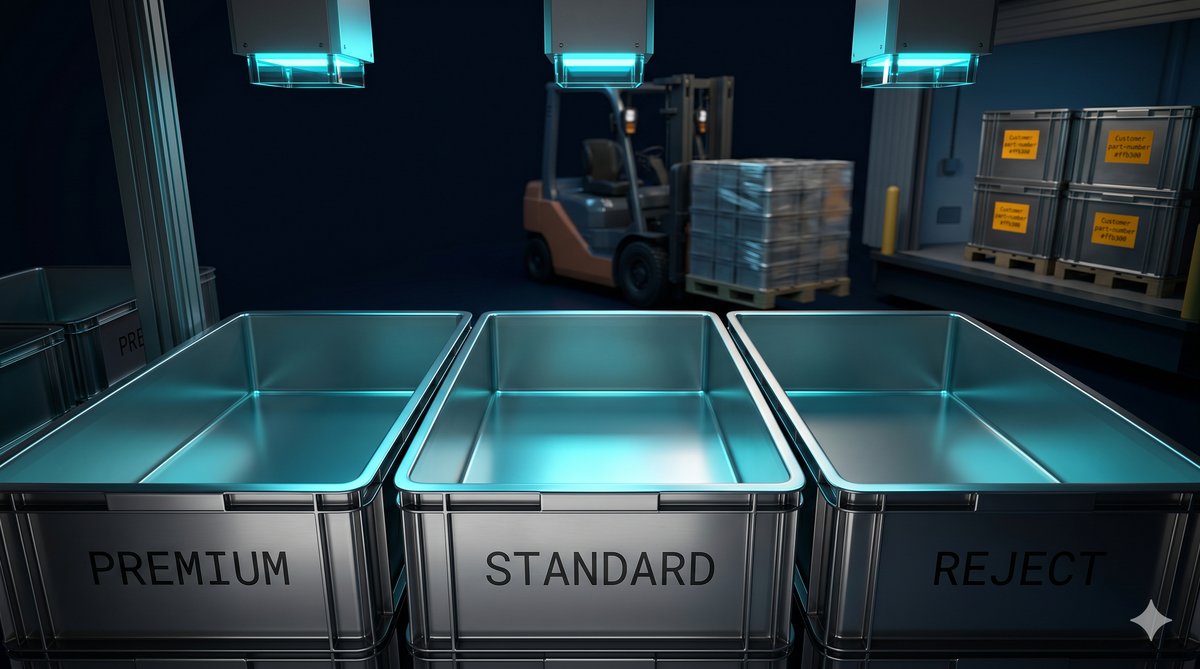
In a normal cycle, a chip that fails to hit its full performance bin gets discounted heavily, sold into a low-end SKU, or written off. In this cycle, Intel confirmed customers are buying that chip at margin. Investor relations called it "yields improving faster than expected." The supply chain reads it differently — when the rejection bin clears, you have crossed into allocation in everything but name.
The bin floor clears for one reason: demand saturation. The premium bins were spoken for first — HPC and AI workloads absorbed the advanced-node capacity. Customers needing volume rather than peak spec then reached down the ladder, accepting parts they would have rejected six months ago because there is nothing else to buy. Off-spec inventory that distributors normally use as a price-discount lever stops working as a lever when there is no alternative.
This is the most procurement-actionable signal in the week. There is no slack in the system. No node. No spec.
If your bill of materials includes Intel CPUs at any spec tier, the price discipline you negotiated twelve months ago no longer reflects supply. Re-quote. The "we'll take what we can get" buyer behavior Intel is now monetizing is the early-stage allocation regime — by the time it has a name, you are already inside it.
Two adjacent Intel signals reinforce the trajectory and matter for procurement teams modeling Intel Foundry as a future supplier. The yield improvements were named on new nodes specifically — Wildcat Lake on 18A shipped two weeks ago, and the production stack is maturing faster than the prior-quarter roadmap drew it. And Intel quietly reallocated discrete gaming GPU capacity for the Xe3P "Celestial" architecture toward datacenter and workstation parts. Wafer demand that was committed to consumer is shifting upstream, which tightens the assumptions other foundry customers can make about Intel's external capacity offer.
The Trajectory
Texas Instruments beat its own original guidance by five cents — a small number that means something specific against the trajectory management drew three months ago.
That trajectory had industrial recovering high-teens year-over-year but still about twenty-five percent below the 2022 peak. Data center reaching $1.5 billion at 9% of revenue with 70% year-over-year growth. Strategic inventory at $4.8 billion or 222 days. Lead times stable below 13 weeks, with many products at 6. Capex stepping down from $4.6 billion in 2025 to $2-3 billion in 2026.
The five-cent beat says all of it just got steeper.
The next thing to watch is lead times. The 222-day inventory cushion that absorbed the prior cycle's downturn is now buffering an upside surprise — TXN can hold lead times stable longer because of it, but the moment the buffer compresses below roughly 190 days, lead times won't drift. They'll snap.
Industrial sitting twenty-five percent below the 2022 peak suggests the recovery has eighteen-to-twenty-four months of headroom before allocation pressure forms in the broad analog market. The inflection point is not Q2 2026; it's the year-over-year compounding through Q4 2026 and into 2027.
The CHIPS Act Investment Tax Credit stepped up from 25% to 35% effective January first this year, which means TXN's net capex burden in 2026 is materially lower than the nominal $2-3 billion guide. If Q2 demand surprises further, the company has financial headroom to revise capex back up without breaking the "past the elevated-investment phase" narrative.
The Sherman 300mm fab ramped ahead of schedule and the Lehi insourcing of Embedded Processing completed the 65nm transition at foundry-equivalent yields. TXN MCU and embedded availability is decoupling from external foundry constraints, which changes the supplier-risk profile for those parts.
Lam Research held its gross margin near fifty percent on the March quarter. Equipment companies do not hold that margin when fabs are negotiating from doubt. They hold it when the wafers those tools will produce are pre-sold. Lam's margin is the upstream confirmation of the foundry capex environment — fabs are paying full prices for 2026-27 tooling, which means the order book through that window is committed. Advanced-packaging overflow to ASE and Amkor continues; CoWoS allocation remains the binding constraint on AI accelerator programs.
The pattern across all three: the suppliers themselves are revising their own forecasts upward. Intel on yields. TXN on segment trajectory. ASML on order intake. The operative question is no longer whether the cycle is real. It's how much more steepening the next quarter brings — and whether the existing capacity buffers absorb it or break against it.
The Pressure Intensifies
Samsung's union demonstrated this week that supply-chain risk is not only about capacity and capital. A single one-day strike cut night-shift production by up to 58%. The union is now threatening an 18-day extended action, with rallies of 40,000+ people demanding $400,000 bonuses.
Samsung is the world's largest memory maker and a top-three foundry. Every BOM line that traces to Samsung memory or foundry capacity needs a contingency note this week, with an explicit qualification timeline if the strike extends. The qualification cycle for memory is non-trivial — start it before the strike duration is announced, not after. If the 18-day action materializes, channel inventory days drop below 100 by Q3 in the affected memory segments.
Omdia raised its 2026 semiconductor forecast to growth of 62.7%, with DRAM nearly doubling and NAND potentially quadrupling year over year. Forecasters move full-year prints from low double-digits to ~60% only when price evidence forces the model. The model just got forced.
If you have not re-quoted memory-bearing BOM lines in the last 30 days, do it this week. The spot-versus-contract spread is widening, and contract pricing escalation continues into Q3-Q4.
The leading-edge ecosystem is forming faster than the prior-quarter roadmaps assumed. Cadence and TSMC announced an expanded EDA collaboration covering N3, N2, A16, and A14 — the third A14 commitment in 2 weeks, alongside Analog Bits demonstrating IP on N2P at the TSMC 2026 Technology Symposium and Applied Materials introducing two new deposition systems for angstrom-era logic chips.
Equipment, EDA, and IP commitments are arriving in the same week. The lead time between equipment-vendor product launches and fab production for the next-next node has compressed materially. If you are modeling 2027 or 2028 leading-edge availability, pull your assumptions in by six-to-twelve months.
Japan's NEDO awarded SoftBank's SaiMemory subsidiary funding for Z-Angle Memory — a "lower-power HBM" architecture being co-developed with Intel. The directional signal is meaningful even without disclosed grant size or timeline. Japan is materially funding a structural alternative to the Samsung / SK hynix / Micron HBM oligopoly, and Intel's involvement extends the Foundry-customer narrative into a memory co-development angle. If ZAM ships in volume by 2028, the HBM pricing dynamics that anchor AI accelerator BOM cost shift.
The export-control regime is now in a contradictory motion. CFIUS this week blocked Sanan Optoelectronics' $239 million bid for Dutch lighting firm Lumileds for the second time. BIS continues the licensing-staff degradation. Restrictions are tightening on every front.
At the same time, DeepSeek released V4 — a 1.6-trillion-parameter frontier model — running on Huawei chips, alongside fresh U.S. accusations of AI IP theft. A fully domestic Chinese frontier-AI stack now demonstrates that the policy goal of denying frontier compute is being eroded by a working alternative. Both directions are escalating simultaneously. That is the trajectory to model — not a tightening or a loosening, but both at once.
What to Watch For
The diagnostic conditions to monitor over Q2-Q3, distinct from the immediate-week actions below.
- Allocation language on Q2 calls. Intel selling rejection-bin parts at margin is the precondition for an explicit allocation announcement. Expect official allocation language on the Q2 calls from Intel and at least one major analog supplier within 90 days.
- Memory pricing escalation through year-end. Omdia's revision combined with Samsung labor risk and the lithography order book reflecting memory sold out for 2026 puts contract pricing escalation on a one-to-two-quarter cadence through Q4. DRAM contract prices rising more than 10% quarter-over-quarter in Q2 is a working assumption, not a tail scenario.
- Lead-time inflection in analog. The 222-day TXN inventory buffer is the visible cushion; the inflection comes when it drops below roughly 190 days, or when lead times move past 14 weeks anywhere in the portfolio. Either crossing means the analog cycle has shifted from recovery into allocation.
- Leading-edge timeline compression. A14 IP, EDA, and equipment commitments arriving in the same week say the 2027-2028 production stack is being assembled now. Capacity contingency belongs in 2027 plans, not 2028 plans.
- Equipment cycle sustained through 2027. Tool lead times for advanced deposition, etch, and lithography are likely to extend rather than normalize through 2026-27. Suppliers running multi-year capex programs should model delivery dates against extended tool windows, not original schedules.
- Trade regime intensifying in both directions simultaneously. Compliance flow-down planning needs to account for tightening rules AND for the realistic probability that further tightening accelerates substitution rather than constraining it. Plan for both.
What To Do This Week
Immediate sourcing actions, narrower scope than the conditions above.
- Re-quote Intel-bearing BOM lines. Late-2025 pricing no longer reflects supply.
- Re-quote memory-bearing BOM lines within 30 days. DRAM nearly doubles, NAND potentially quadruples.
- Add a Samsung labor-risk note to exposed BOM lines. Start secondary-source qualification before the strike duration is announced, not after.
- Pull leading-edge timeline assumptions in by six-to-twelve months. A14 is real and forming earlier than the roadmaps assumed.
- Audit your Intel Foundry RFQ position. Yields improving on new nodes plus the discrete-GPU pivot shifts the qualification math; if you held off in 2025, the math has changed.
- Document U.S. manufacturing positioning for the tariff offset program. Section 232 Phase 2 is unresolved; CFIUS continues blocking; the trade environment is hardening regardless of which way the next decision goes.
The structural picture is louder than it was a week ago. The buy side described the constraint. The sell side opened the books on it.
Intel selling scrap. TXN beating its own guidance by enough to read a steepening cycle. Lam holding margin to confirm the equipment supplier sees no slowdown. Samsung's labor risk landing on top. Omdia raising the year. The leading-edge ecosystem assembling earlier than the roadmaps assumed. The export-control regime hardening while its effectiveness erodes.
The suppliers are revising their own forecasts upward. The structural picture is now confirmed by both sides of the trade.
Supply Signal Radar is the free weekly brief at semibuffer.com/radar. Signal Chat is live at semibuffer.com/signal-chat — ask questions and get answers that cite the signals behind them.
Sources: Intel, Texas Instruments, and Lam Research Q1 2026 earnings releases (SEC EDGAR, April 22–23). Tom's Hardware reporting on Intel yield commentary, the Samsung labor action, the Xe3P discrete-GPU pivot, and DeepSeek V4 / Huawei. Semiconductor Digest reporting Omdia's 2026 forecast and the Cadence–TSMC EDA expansion. SemiWiki on Analog Bits at the TSMC 2026 Technology Symposium. Texas Instruments prior-quarter framing draws on the Q4 2025 earnings call commentary. Published weekly by Semibuffer Intelligence.
Related Episodes
- Week 17: The Other Side of the Trade Speaks: Week 17 tracks Intel’s bin-floor signal, Texas Instruments’ inventory cushion, and Lam Research demand as earnings reveal how the structural semiconductor gap is showing up across suppliers.