Supply Signal
When Every Buyer Acts Like a Government, the Market Isn't a Market Anymore
By Semibuffer Intelligence | April 12, 2026 | 16 min read
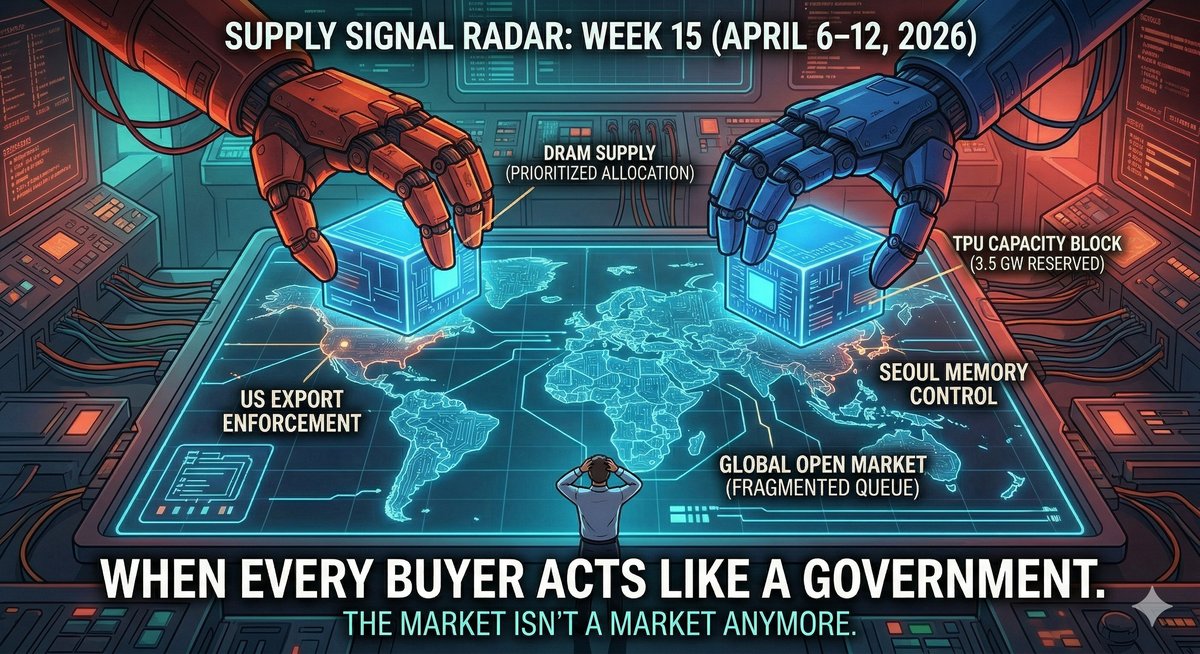
Last week, Supply Signal Radar tracked $200 billion in industry CapEx, NOR Flash entering shortage, and counterfeit AI chips reaching market. This week, the ledger got shorter and the actors got bigger: two governments stepped directly into semiconductor markets, three hyperscaler-scale deals locked up multi-year capacity, and U.S. export enforcement produced another $92 million in seized hardware.
These look like four separate stories. They're one story. Sovereign governments and hyperscaler-scale enterprises have entered the semiconductor arms race as active participants — not as regulators or customers, but as strategic buyers using policy tools, multi-year capacity reservations, and export enforcement to secure supply for themselves. South Korea is protecting domestic memory allocation. The U.S. is criminalizing unauthorized access to advanced chips. Anthropic is reserving 3.5 gigawatts of TPU capacity through 2027. Each of these actions removes supply, pricing leverage, or both from the open market before a mid-market buyer ever requests a quote.
The consequence at the local negotiating table is concrete. When a procurement lead sits down with a distributor or fab rep in 2026, the price quoted and the lead time offered have already been shaped upstream — by Seoul deciding what leaves Korea first, by Washington deciding who is allowed to buy at all, and by hyperscalers who pre-committed to the capacity blocks everyone else is now queuing behind. Counter-offers, volume leverage, and long-standing supplier relationships still matter, but they operate inside a ceiling set by actors who are not at the table and are not competing on local terms. The practical result is higher prices, longer scarcity, and allocation decisions that look less like market behavior and more like triage.
That is the shift worth naming this week.
The Memory Crisis Becomes a Political Instrument
The most direct evidence that semiconductor allocation has become state business came from Seoul and Taipei.
South Korea is intervening in DRAM and NAND pricing. The government is monitoring memory prices and restructuring consumer mobile data plans in response to cost inflation rippling through the domestic economy. This is not a market signal — it's a government concluding that memory pricing has become severe enough to warrant policy action. South Korea is home to Samsung and SK Hynix, two of the world's three major memory producers. When that government intervenes in its own producers' pricing, the probability of near-term relief drops, and the probability of politically prioritized allocation — domestic consumers and strategic buyers first, everyone else second — rises.
Taiwan's TSIA is urging its government to stockpile helium and LNG and to restart nuclear power plants. Helium is non-substitutable in wafer fabrication. LNG underpins fab power. A disruption to either forces output reductions across Taiwan's foundry ecosystem — TSMC included. This echoes the Qatar Ras Laffan helium disruption tracked in W11 and the Strait of Hormuz blockade risk flagged in W12. What's new is that Taiwan's industry body is now treating the risk as imminent enough to ask the state to act.
The pricing data underneath these interventions justifies the alarm. Enterprise SSD costs are up 472% for 30TB TLC drives, now trading at 22.6 times the cost of equivalent hard drives. The Vdura Flash Volatility Index was revised to reflect sustained NAND price escalation. Framework issued OEM-level pricing warnings. RAM and SSD prices are expected to continue rising through the remainder of 2026.
Government intervention is a lagging indicator. But it is a high-conviction one: the crisis has crossed the threshold from industry problem to political problem, and political problems don't resolve on procurement-friendly timelines. For buyers, that means current memory pricing should be modeled as durable, not transient — and allocation risk should be modeled as non-neutral, because governments protecting their own demand will distort the queue.
Three Deals, One Behavior: Capacity as Sovereign Reserve
The same week that Seoul and Taipei were acting like states, three private-sector deals surfaced that are structurally indistinguishable from sovereign capacity reserves.
Broadcom disclosed a 3.5-gigawatt TPU deal with Anthropic starting in 2027 — one of the largest disclosed AI chip capacity commitments on record. 3.5 gigawatts is more power than many small countries consume. This is not a purchasing decision. It is a multi-year territorial claim on advanced packaging, CoWoS, and substrate capacity at TSMC and the major OSATs. Anthropic is not buying chips. Anthropic is reserving a fraction of the global bleeding-edge manufacturing base, in advance, for itself.
Reports surfaced of an Intel "Terafab" pact with Tesla, SpaceX, and xAI as anchor customers. Confidence is low — these are early-stage reports and announced fab deals have historically shrunk between announcement and groundbreaking. But the customer list is the tell: three companies controlled by or adjacent to Elon Musk, each with strategic national-security-adjacent semiconductor demand (autonomous driving, satellite communications, AI training). If this materializes, it is a private consortium buying the behavior that CHIPS Act funding was designed to subsidize — anchoring U.S. domestic advanced capacity for politically-aligned strategic buyers.
Intel is reportedly in talks with Google and Amazon for EMIB-T advanced packaging for custom AI ASICs. Again, nothing signed. But the direction is that hyperscalers are actively shopping for alternatives to TSMC packaging and courting U.S. foundry capacity. The commercial logic is cost and availability. The structural logic is the same one playing out in Seoul: dependence on a single geography for a strategic input is no longer acceptable to the largest buyers.
A fourth data point belongs here, even though it's smaller. SiFive raised $400 million at a $3.65–3.75 billion valuation for RISC-V data center CPUs. This won't affect 2026 procurement — RISC-V data center silicon isn't yet at scale — but hyperscalers funding an open ISA alternative to x86 and Arm is part of the same pattern: reducing exposure to any single supplier, architecture, or geography.
Taken together, these four deals represent tens of billions of dollars of capacity pre-allocation in a single week. None of it is available to the rest of the market. The mid-market buyer showing up to TSMC in 2027 with a forecast and a PO is queuing behind commitments that were priced and placed years earlier, by buyers who no longer assume the market will be liquid when they need it.
Export Controls: The U.S. Government Is Doing the Same Thing
U.S. AI chip export enforcement took another specific step this week — and it belongs in the same frame.
A Chinese Nvidia cloud partner procured 300 servers containing banned H100 GPUs worth $92 million. Super Micro faces a smuggling arrest. Sharetronic's shares plummeted on disclosure. This builds directly on the Super Micro prosecution Supply Signal Radar has tracked since W12: indictment, W14 not-guilty plea, and now procurement-level detail on the scale of the smuggling operation.
This is a government securing strategic supply by preventing counter-allocation. The mechanism is different from Seoul's price monitoring or Anthropic's 3.5 gigawatts, but the behavior is the same: the state is directly shaping who gets access to advanced semiconductors. The U.S. is not just writing export control rules. It is building criminal cases with dollar amounts and server counts, and the compliance cost is being paid in indictments and collapsed share prices.
China-U.S. trade consultations continued, with MOFCOM engaged in a sixth round of economic and trade discussions and issuing remarks on the EU Industrial Accelerator Act. Three jurisdictions are now actively managing semiconductor flows by policy. The regulatory surface area procurement has to track is no longer a tariff schedule — it's a set of interacting industrial policies.
For distributors, ODMs, and cloud infrastructure suppliers with China exposure, the compliance risk is no longer theoretical. Audit your sales channels now. The subpoena cost is higher than the audit cost.
The Macro Confirms the Microbehavior
Two macro data points this week confirmed why every major buyer is behaving this way.
Global semiconductor equipment billings hit $135.1 billion in 2025, up 15% year-over-year. This is a trailing indicator, but it confirms the equipment supercycle is real and accelerating. Lead times for lithography, etch, and deposition tools will tighten further as 2026 orders compete with existing backlog.
Global semiconductor sales surged 61.8% year-over-year in February 2026. A 61.8% increase is an exceptionally strong demand signal. Capacity that appeared available in 2024–2025 is being rapidly absorbed, with advanced logic, memory, and AI-related demand all contributing simultaneously. No segment is acting as a pressure relief valve.
This is the environment in which Anthropic reserves 3.5 gigawatts and Seoul monitors DRAM pricing. When every segment is short and demand is growing at 60%+ year-over-year, rational large buyers stop behaving like price-takers and start behaving like states.
The week did contain two capacity-positive countersignals worth naming. HANMI Semiconductor plans to launch a prototype second-generation hybrid bonder for HBM production by year-end, potentially easing the Besi-dominated bottleneck in HBM packaging at SK Hynix, Samsung, and Micron. And Everspin Technologies signed a strategic manufacturing agreement with Microchip Technology for on-shore U.S. MRAM production, expanding a critical component's domestic base. Both matter. Neither is fast. Prototyping is not production, and new fab capacity doesn't ship until the decade turns. They are the right direction at the wrong speed.
What This Week Means
Week 15 wasn't a news week. It was a behavior week.
Governments are directly managing allocation. Hyperscalers are buying capacity in units that used to belong to nations. Export enforcement is producing arrests and seizures. And underneath it, demand is running 60%+ ahead of last year with no segment providing relief.
The useful way to read this week is not "more bad memory news." It is: every actor with real capital is now treating semiconductor capacity as strategic, not transactional. That behavior, once it becomes normal, doesn't reverse until supply catches up — and the equipment billings data says supply is still years behind.
For procurement teams operating underneath that behavior, the actions are:
If you source memory, treat current pricing as durable. The floor is now political, not just economic. Lock in allocations through year-end and assume government-prioritized allocation could distort availability even if prices soften.
If your supply chain depends on Taiwan-sourced silicon, ask your suppliers — this quarter — about energy and process gas contingency. TSIA is flagging imminent risk. The cost of asking is zero. The cost of not asking is a fab output cut you didn't model.
If you're competing for advanced packaging or leading-edge logic capacity through 2027, assume the queue in front of you got longer this week. Broadcom-Anthropic alone is a material fraction of advanced packaging supply. Get multi-year contracts in writing; assume spot availability will be worse than your 2025 experience suggests.
If you have China exposure in your AI hardware supply chain, export enforcement is producing indictments in real time. Audit distribution channels now, not after the subpoena arrives.
If you're evaluating Intel Foundry Services, RISC-V, or any second-source alternative, the directional signal is positive but the timelines are long. Treat these as 2027+ options, not 2026 solutions, and price your 2026 plan accordingly.
The shortage was already structural. This week, the biggest buyers in the market stopped pretending it wasn't. When that happens, the rest of the market has to stop pretending too.
Signals tracked this week: 13. Sources: public filings, government announcements, trade press, industry association statements. Supply Signal Radar is published weekly by Semibuffer Intelligence.