Supply Signal
Earnings Week Showed Everyone's Cards. The Fabs Still Aren't Built.
By Semibuffer Intelligence | April 19, 2026 | 6 min read
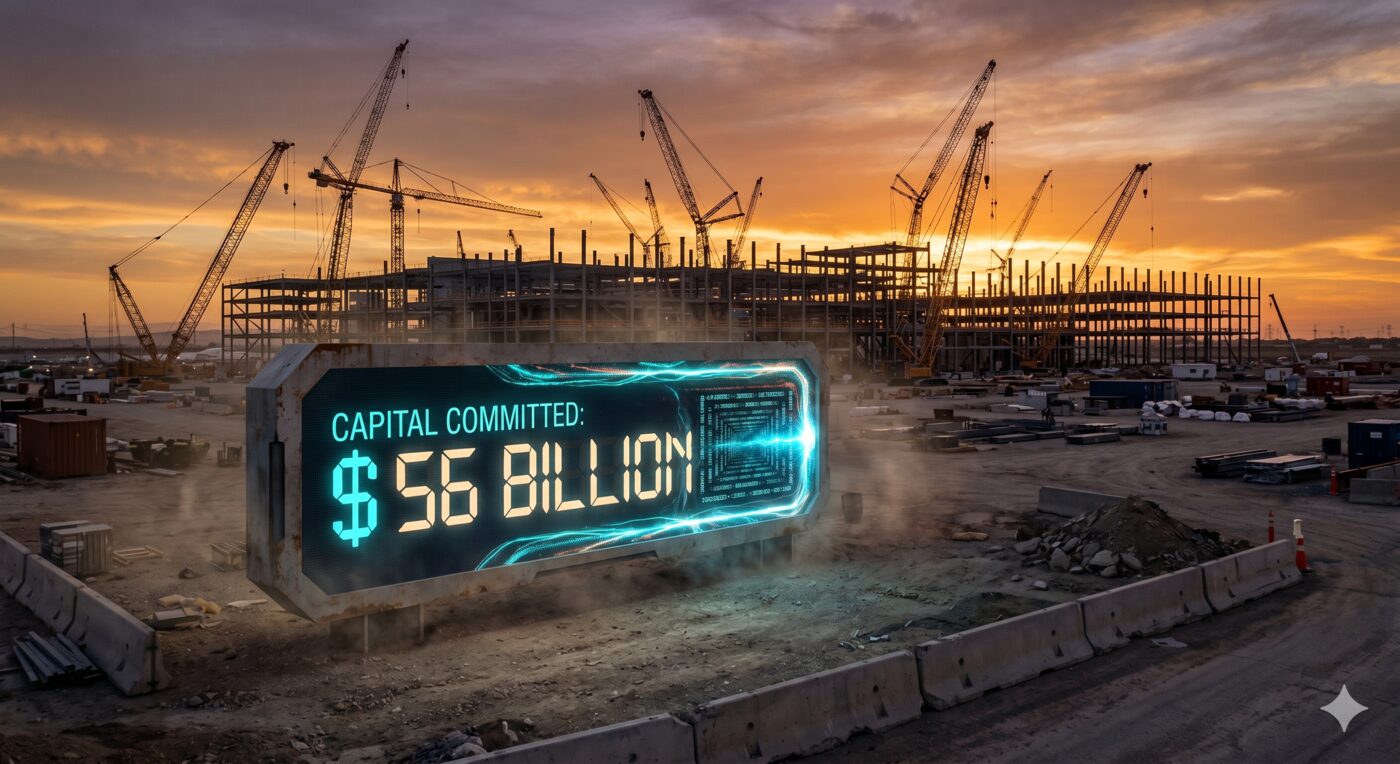
Last week, Supply Signal Radar reported that every actor with real capital is treating semiconductor capacity as strategic, not transactional. This week, earnings season puts numbers on that behavior.
TSMC reports $35.9 billion in Q1 revenue, up 40.6% year-over-year. HPC and AI now account for 61% of every dollar the company earns. ASML raises full-year guidance to €36–40 billion while China's equipment share collapses from 36% to 19%. Meta locks in 1 gigawatt of custom silicon through 2029. Musk's Terafab reaches out to equipment suppliers willing to pay premiums. Intel ships its first 18A consumer silicon.
These are quarterly results, signed contracts, and shipped products. They all say the same thing: demand is accelerating, capacity is locked years in advance, and the gap between capital committed and fabs actually built is widening.
CC Wei, TSMC's CEO, on the Q1 call: "It takes two to three years to build a new fab. No shortcuts. And it takes another one to two years to ramp it up."
The fabs are not built. The money is already spent.
The demand shift underneath the numbers
The most important disclosure this quarter is not revenue. It is the structural demand change driving it.
CC Wei: "The shift from generative AI and the query mode to agentic AI and command and action mode is leading to another step-up in the amount of tokens being consumed. This is driving the need for more and more computation."
Agentic AI — systems that take actions, not just answer questions — consumes significantly more compute per task than generative inference. A generative query is one pass: prompt in, answer out. An agentic task is a chain: the model reasons, calls tools, evaluates results, adjusts, and iterates — often tens or hundreds of inference steps to complete a single job. That multiplier on token consumption is why CC Wei frames it as "another step-up," not a continuation of the current trend. Agentic AI is becoming its own category of silicon demand, distinct from and additive to the generative workloads already straining capacity. If the shift sustains, the demand curve for leading-edge silicon steepens and the supply gap extends well beyond CC Wei's 2027 timeline.
He refines TSMC's AI accelerator revenue CAGR for 2024–2029 to "toward higher 50s" percent — roughly 55–60% annual growth. At that rate, AI accelerator demand doubles every 15 months. No capacity program keeps pace with that.
ASML CEO Christophe Fouquet: "We expect that supply will not meet demand for the foreseeable future." Memory customers tell ASML they are sold out for 2026, with constraints extending beyond.
When the world's most important foundry and the world's most important equipment company both say the same thing on their earnings calls, that is not a forecast. It is a diagnosis.
Where the capacity goes
TSMC's platform mix tells the allocation story. HPC rises 20% quarter-over-quarter to 61% of revenue. Automotive drops to 4%. When procurement teams ask why their automotive or industrial parts face allocation pressure, this is the answer: the fabs run at full capacity, and they run for AI.
The CapEx trajectory makes this permanent. 2026 guidance sits at $52–56 billion, but CFO Jen-Chau Huang frames the scale: "In the past 3 years, our total CapEx was USD 101 billion. This year... is already over 50% of the past 3 years in total. So we expect the CapEx in the next few years will be significantly higher than the past 3 years." Allocation: 70–80% advanced process, 10–20% advanced packaging, ~10% specialty. Every dollar targets hyperscaler and AI workloads.
On the equipment side, ASML reports €8.8 billion in Q1 sales and raises guidance — but China's share falls 17 points in one quarter as DUV restrictions bite. ASML stops disclosing order intake numbers for the first time. When order flow is so strong and geopolitically sensitive that the company removes the data point, the information environment for procurement planning just degraded.
Two under-reported ASML details matter for procurement teams sourcing outside the leading edge. First, immersion DUV demand has reversed. DUV — Deep Ultraviolet lithography — is the older-generation toolset that produces the vast majority of the world's automotive, industrial, analog, and power management chips at nodes like 28nm, 40nm, and 65nm. The market expected DUV demand to decline this year as industry attention shifts to EUV for advanced nodes. Instead, ASML's CFO reported the opposite: "we're still expecting to get pretty close to the immersion sales that we had last year." That means fabs using DUV tools for mature nodes are busier than anyone anticipated, and tool availability at the nodes most OEM procurement teams depend on is tighter than the market assumed. And ASML demonstrates a 1,000-watt EUV source extending Low NA EUV to at least 2031 — the installed base pathway that lets fabs squeeze more from existing tools while waiting years for new ones.
The capacity lock-up continues
Meta's Broadcom deal through 2029 commits 1 gigawatt of MTIA custom silicon — described as "the first phase of a sustained, multi-gigawatt rollout" — fabricated on 2nm. Combined with Anthropic's 3.5 GW Broadcom-TSMC deal from W15, two hyperscalers hold multi-gigawatt reservations through the decade. Every wafer start in those commitments is one that does not go to someone else.
Musk's Terafab moves from announcements to supplier engagement, with staff contacting equipment vendors and offering premiums for priority. Intel joins the project. CC Wei's "no shortcuts" is a direct rebuttal — whether Terafab succeeds is a 2028+ question, but it adds new demand to an equipment supply chain that TSMC's $56 billion program, Samsung's buildouts, and Intel's ramp already fill.
Intel ships Wildcat Lake — six 18A consumer SKUs, 70+ laptop designs — and hires Samsung Foundry's Shawn "Seung Hoon" Han to lead foundry customer acquisition. 18A is no longer a roadmap item. It is in laptops. For procurement teams that dismissed Intel Foundry as unproven, that argument expired this week.
Signals that received no coverage
TSMC is closing 8-inch and 6-inch fabs. Fab 2 (6-inch) and Fab 5 (8-inch) are winding down, resources redirecting to gallium nitride and leading-edge. If your BOM includes analog, power management, or sensors on these lines, qualify GlobalFoundries or UMC alternatives within 12 months.
Advanced packaging is overflowing to OSATs. CC Wei: "Our advanced packaging capacity is very tight also." CoWoS remains constrained. ASE and Amkor absorb overflow. Panel-level CoPoS is 2+ years from volume.
The memory feedback loop is live. CC Wei: "Memory price hike definitely has some impact to price sensitive end market, especially in PC and smartphone." The pricing that makes NOR Flash scarce and DRAM expensive is now dampening demand for the devices consuming those parts. Combined with ASML's "sold out for 2026" confirmation, the memory market is simultaneously constrained and demand-destructive at the low end.
Policy: enforcement frays as restrictions tighten
BIS has lost ~20% of its licensing staff, stalling export approvals. Jensen Huang calls China restrictions a "losing proposition." ASML's guidance already prices in further restrictions. The Super Micro prosecution from W12–W15 shows chips reach China anyway through smuggling operations that BIS's depleted staff must now investigate. The policy trajectory tightens while enforcement capacity degrades.
The Section 232 90-day deadline hit April 14 with no public announcement. Phase 1 — a 25% tariff on advanced AI chips — is in effect. Phase 2 could broaden tariffs with an offset program for U.S. manufacturing. A July 1 data center semiconductor report adds a second trigger. Model both scenarios now.
Capital flow
Molex acquires Teramount (fiber-to-chip connectivity for Co-Packaged Optics). Teradyne acquires TestInsight (design-to-test software). Silicon Box joins imec's Automotive Chiplet Program. Eighty semiconductor startups raise $8.4 billion in Q1. ESD Alliance reports $5.5 billion in Q4 2025 design tool revenue, up 10.3% — double-digit growth in chip design tools means more tape-outs and more fab demand 12–18 months from now.
What this week means
CC Wei: supply is "very tight" into 2027. Fouquet: "supply will not meet demand for the foreseeable future." Memory is sold out. TSMC spends $56 billion this year and says the next three years dwarf the last. The AI accelerator CAGR is 55–60%, driven by a structural shift to agentic AI.
The gap between capital committed and capacity delivered is widening. For procurement teams: advanced logic allocation is confirmed through 2027 — do not model unconstrained availability before 2028. Memory pricing is durable (active forecast QD-2026-014: DRAM >10% QoQ in Q2, probability 0.70). TSMC's 8-inch and 6-inch closures require alternative qualification. Equipment timelines are less certain with Terafab in the queue and DUV demand reversing. BIS processing is degraded. Tariff Phase 2 is unresolved.
The structural picture has not changed. It has gotten louder.
A note from Supply Signal
This analysis is built on the public evidence: earnings calls, SEC filings, press releases. The specific signal IDs, SNR scores, entity maps, and transcript-level evidence behind the forecasts referenced above are part of a deeper layer we're building.
Supply Signal Radar is the free weekly summary found at semibuffer.com/radar.
Signal Chat is live at semibuffer.com/signal-chat — ask questions and get answers that cite the signals behind them: signal IDs, SNR scoring, named foundry sources, entity-level impact maps, and the reasoning chain behind every forecast.
Signals tracked: 37. Sources: TSMC Q1 2026 earnings call transcript, ASML Q1 2026 earnings call transcript, SEC filings, Broadcom/Meta press release, trade publications, government policy documents. Published weekly by Semibuffer Intelligence.