Supply Signal
The Money Showed Up. The Permission Didn't.
By Semibuffer Intelligence | July 19, 2026 | 7 min read

The bottleneck stopped being a fab.
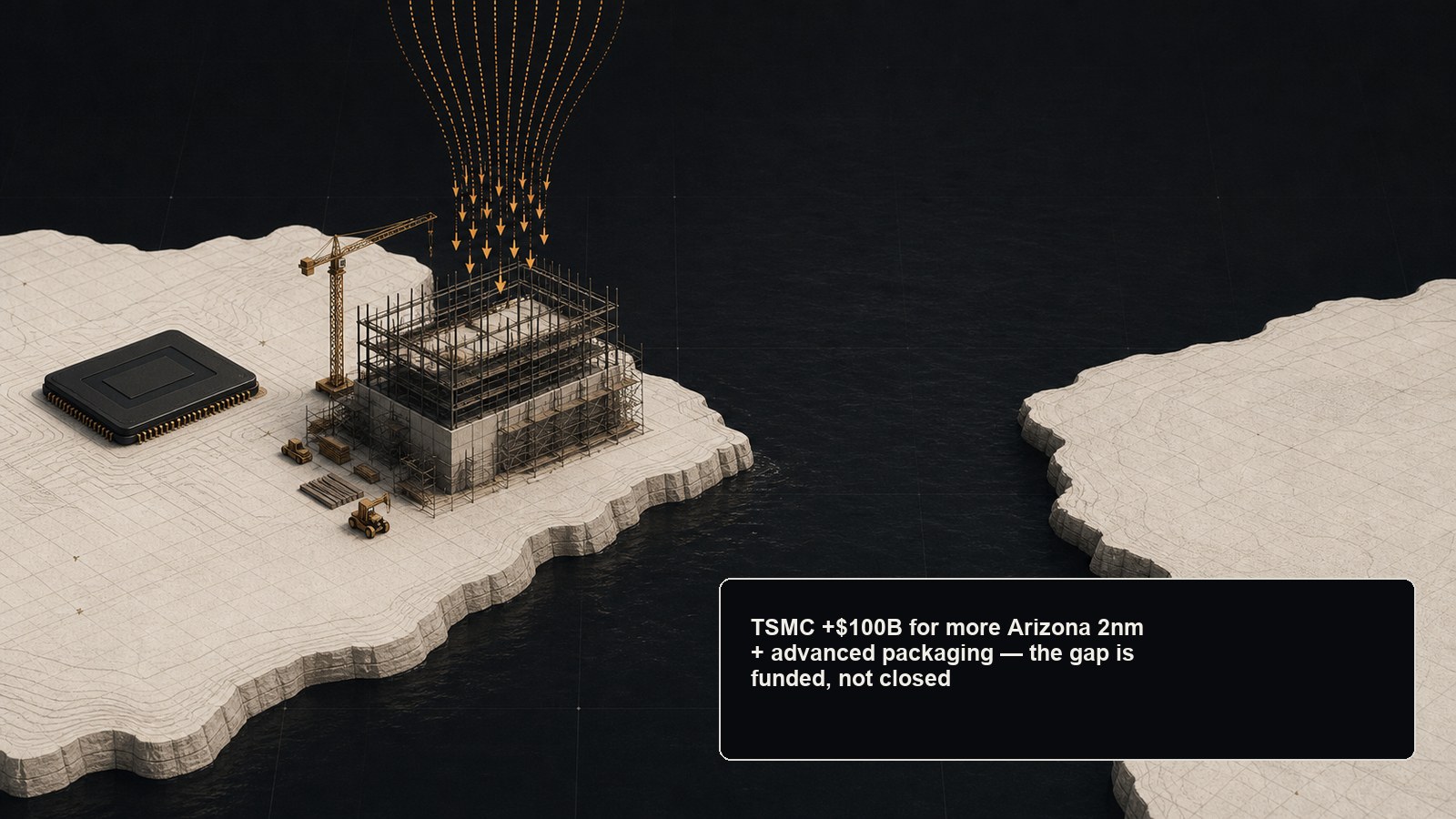
The packaging gap now has money behind it. TSMC lifted the top of its 2026 capital-spending range from $56 billion to $64 billion and committed another $100 billion to at least four more Arizona fabs at 2nm or more advanced, with advanced packaging included in the buildout. The investment answers the missing step between an Arizona-made die and a finished accelerator.
It does not make that supply available this quarter. The fabs, packaging lines, tools, power connections, permits, and customer qualifications still have to arrive in sequence. The gap is being funded. It is not closed.
That distinction is the week's procurement lesson. Capital can buy a cleanroom. It cannot buy a state environmental permit, a grid connection, or permission to place a 50MW load next to a community that has not agreed to carry it.
The Money Answered the Packaging Gap
For buyers planning domestic AI hardware, the useful change is the location of the commitment. TSMC's additional $100 billion is aimed at four more Arizona fabs producing 2nm-class and more advanced chips, alongside advanced packaging facilities.
That answers the dependency: a wafer could be made in Arizona while the advanced packaging still happened in Taiwan. A package is where the compute die, HBM, interposer, substrate, bonding, and test steps become a shippable product. Moving that work closer removes a transport leg and a geopolitical handoff. It does not remove qualification or ramp time.
ASML said it plans to expand Low-NA EUV capacity by 30% in 2027 and is investigating another 30% increase in 2028. SEMI expects global semiconductor equipment sales to reach a record $165.9 billion in 2026 and $229 billion in 2028. These are commitments to future supply of the tools that make future supply.
They are not allocation letters. A buyer still needs the supplier's package location, production date, qualified process, substrate path, and delivery commitment before counting the capacity in a clear-to-build plan.
You Cannot Buy a Permit
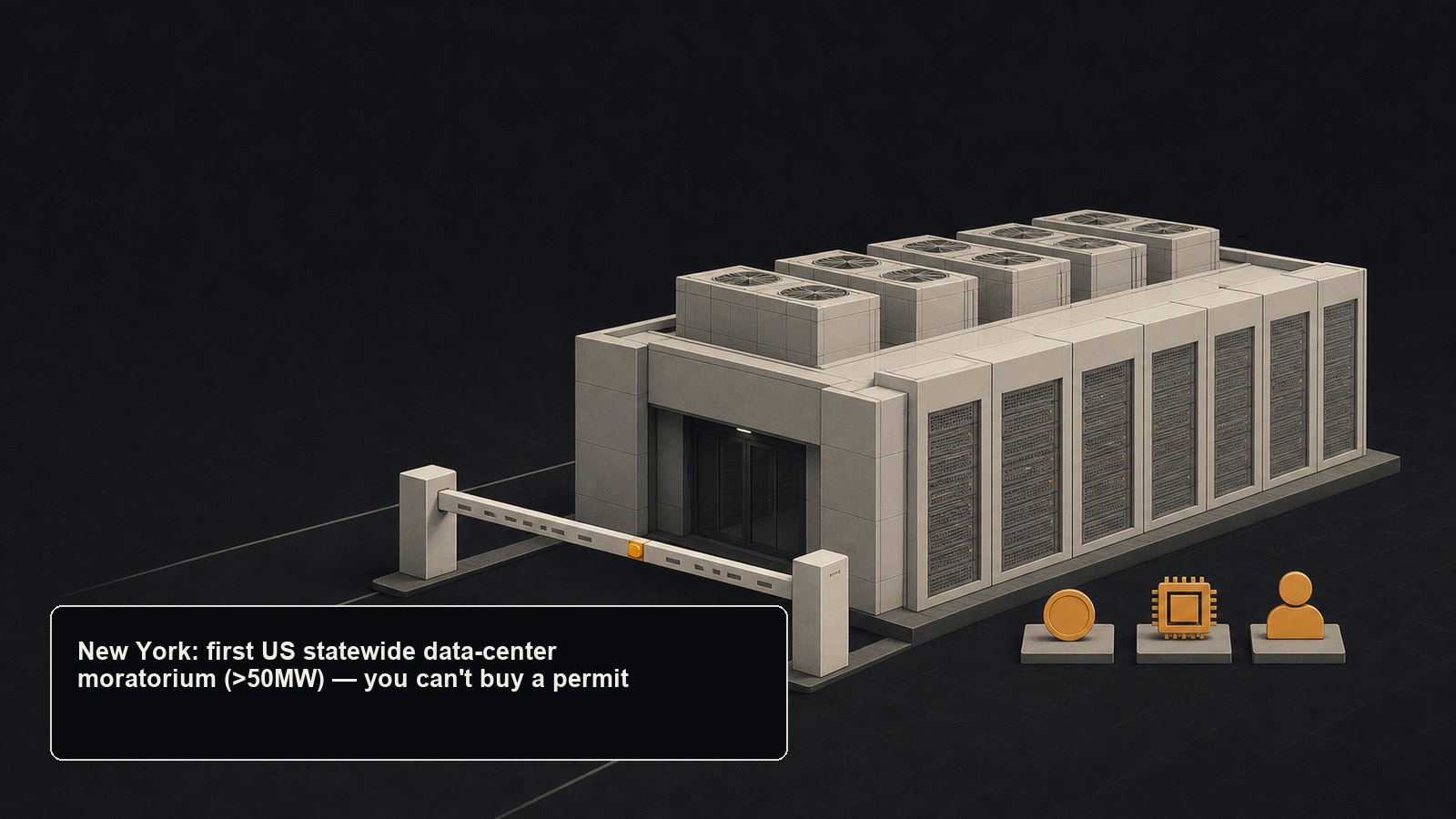
The new gate is visible in New York. Governor Kathy Hochul's July 14 executive order created a statewide pause of up to one year on state environmental permits for new hyperscale data centers drawing 50MW or more. New York described it as the first statewide data-center moratorium in the United States. The administration is also pursuing repeal of data-center tax exemptions.
The order is one state's policy and one year's pause. It is not a national ban. It is still a meaningful change in the siting equation: a project with financing, chips, and a customer can now be held at the permit stage while the state evaluates grid demand and ratepayer impact.
The same permission question is moving through the memory supply base. Two U.S. lawmakers asked Commerce to block American companies from buying memory made by Chinese suppliers including CXMT and YMTC, and urged coordination with Japan, South Korea, and the European Union. That is a policy request, not a final import rule. For a buyer, the practical issue is provenance: a part that is technically available can still become commercially unusable if the end market or customer contract rejects its origin.
Nvidia is reportedly applying that logic to its own channel. The Financial Times reported that Nvidia cut more than half of its verified Asia customer list, added field inspectors, and required physical data-center checks and contract verification. If accurate, accelerator access now depends on proving who will operate the hardware and where it will run, not just on having a purchase order.
Power and channel access have joined capacity as approval gates. That changes the risk review from "can we buy the chip?" to "can we prove the chip, site, power, and end use will all be accepted?"
It Costs More to Build the Capacity Too
The cost migration is moving upstream. ASML's chief financial officer said the company sees room for price improvements on Low-NA EUV tools. Reports of planned price increases have raised the possibility of billions of dollars in additional TSMC capital spending, with the eventual pass-through showing up in advanced-node wafer quotes.
That pricing story needs careful handling. ASML's reported willingness to capture more of the value of its tools is not the same thing as an announced customer surcharge, and the "billions" framing is a reported estimate rather than TSMC guidance. The procurement point survives the caveat: new capacity is becoming more expensive before it produces a single additional wafer.
Intel's $5.7 billion modernization of its Leixlip, Ireland campus points in the same direction. The company says it will expand output of Xeon 6 and next-generation Xeon platforms on Intel 3. Japan's Noetra project gives the demand side a concrete scale: a planned 140MW AI factory with 27,500 Rubin GPUs and 13,750 Vera CPUs.
Reportedly, 3GB GDDR7 modules cost two to three times as much as 2GB modules, putting Nvidia's RTX 50 Super launch on hold despite production-ready boards. Confidence is low, but the illustration is vivid: memory cost can stop a finished product.
Our standing call remains that contract DRAM rises more than 10% quarter over quarter this quarter. Chey Tae-won, chairman of SK Group, called RAM prices "abnormally high" and warned that sustained high pricing could bring in new entrants. That corroborates the direction and supplies the counter-signal at the same time. New-entrant risk is later pressure on pricing, not evidence that this quarter's increase has reversed.

What to Watch For
- Arizona packaging execution. Firm construction milestones, customer qualification, and first usable output matter more than the $100B headline.
- New York's permit and tax path. The scope of the moratorium, the treatment of projects already in review, and the tax-exemption repeal effort will show whether one state's pause becomes a repeatable siting template.
- ASML tool pricing and availability. Watch for customer-specific pricing, Low-NA EUV delivery slots, and the 2027-2028 capacity additions.
- Memory provenance rules. A proposed restriction has to become a rule before it changes an approved-parts list, and a rule still has to reach the customer's end-market requirements.
- Accelerator inspection requirements. Physical-site checks and end-user verification can add lead time even when allocation is secured.
- Contract DRAM. A move above 10% quarter over quarter keeps the standing call on track. A clear slowdown would be the first sign that the near-term pricing read is losing force.
What To Do This Week
- Rebuild the capacity plan with permission gates. Put permits, interconnection, tax treatment, customer qualification, and end-use approval beside fab, package, and rack milestones.
- Treat Arizona capacity as future supply. Do not remove a Taiwan packaging dependency until the U.S. line has a production date, a qualified customer path, and an output commitment.
- Add provenance to the approved-parts record. Capture wafer origin, memory die source, assembly site, end market, and any customer-specific restrictions before release.
- Reprice advanced-node exposure. Model a Low-NA EUV pass-through in wafer quotes and shorten quote-validity assumptions where the supplier's tool cost is still moving.
- Get the site and power decision in writing. For compute programs, record the interconnection date, tariff exposure, permit status, and the load that the utility has actually accepted.
- Keep a second memory path alive. Preserve alternates, contract coverage, and a lifetime-buy decision for products that cannot wait for the next capacity wave.
The money is arriving at every upstream layer: fabs, packaging, tools, equipment, and data centers. That improves the long-term supply picture. The operational part is harder. Each new dollar still has to pass through a permit, a power contract, a qualification run, or an end-use rule before it becomes usable supply.
The shortage's next deadline may be set by the place that has to approve the fix.
Chat with Sai — the first month is free for new subscribers. Signal Chat is direct conversational access to Supply Signal, the intelligence agent behind this Radar. Ask which memory generations are repricing, where a foundry pass-through lands on your BOM, or whether a supplier's notice is a temporary surcharge or a new baseline — every answer carries its reasoning and its sources, and every prediction goes on a public, auditable track record. New subscribers get the first month free at semibuffer.com/auth/sign-up. The free weekly brief is at semibuffer.com/radar.
Sources: Arizona Commerce Authority on TSMC's additional Arizona investment, AP on TSMC's capex and Arizona plan, the New York Governor's executive-order announcement, Data Center Dynamics on the 50MW moratorium and tax-exemption effort, ASML's Q2 2026 release, the reported Low-NA EUV pricing impact, lawmakers' proposed Chinese-memory restrictions, reported Nvidia customer-list and inspection changes, Chey Tae-won on RAM pricing, Intel's Leixlip investment, and the Noetra AI factory report. Published weekly by Semibuffer Intelligence.
Related Episodes
- Week 29: The Money Showed Up. The Permission Didn't.: Week 29: TSMC committed ~$100B more to Arizona 2nm fabs and advanced packaging, funding the packaging gap — but New York's first US statewide data-center moratorium moved the binding constraint from capacity to permission. The money is arriving at every upstream layer; each dollar still has to pass a permit, a power contract, or an end-use rule.