Supply Signal
The Recovery Is a Number Now. Allocation Is Next.
By Semibuffer Intelligence | May 10, 2026 | 9 min read
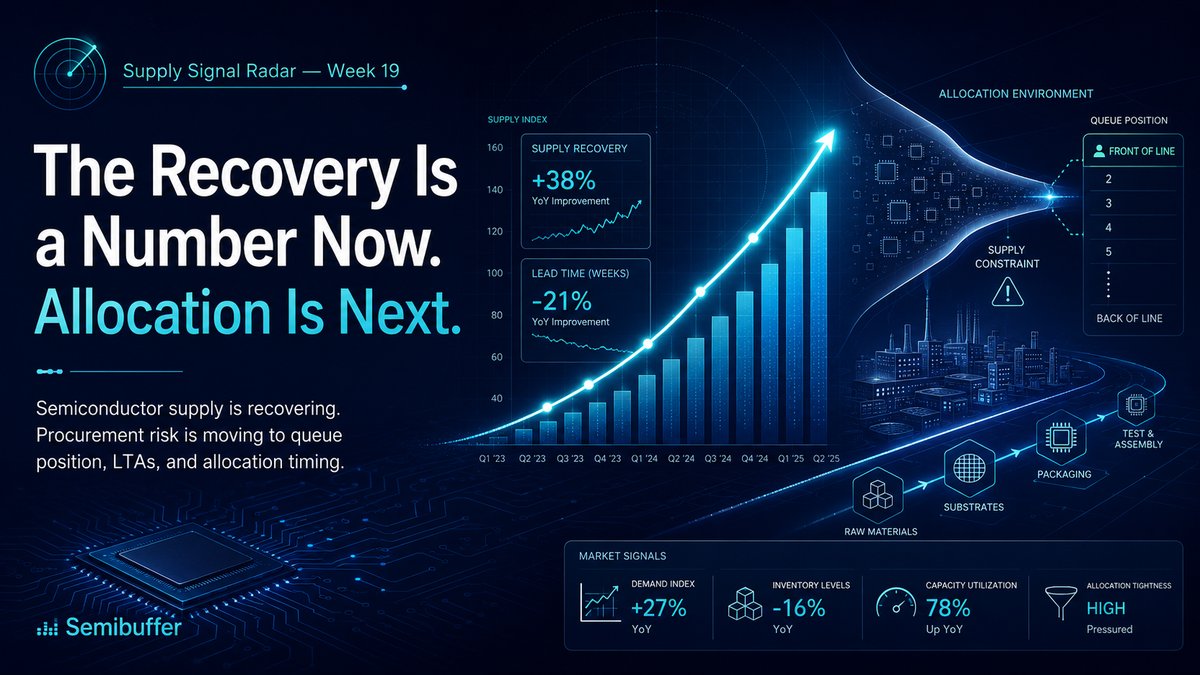
The chip industry stopped arguing about whether the recovery is real this week. The European Semiconductor Industry Association reported Q1 2026 global chip sales of $298.55 billion — up 79.2% from a year ago. That number is too big to revise away. Forecasters move full-year prints from low double-digits to over 20% growth. The conversation moves on.
The conversation it moves to is allocation. Six earnings prints, one record-setting bond, and a wave of five-year long-term agreements all point in the same direction: capacity for 2026 and 2027 is being claimed now, by the customers who decided early that this recovery is durable enough to commit to.
onsemi reported Q1 2026 revenue of $1.311 billion, up 35.1% sequentially, and guided Q2 to a midpoint above the Q1 print. Management raised 2026 capex to $18 billion and named automotive and industrial as the demand drivers. Microchip reported $1.513 billion in revenue and described book-to-bill above 1.0 across every product line for the first time in eight quarters. Infineon's quarterly print and forward commentary matched the pattern. Three of the largest analog and mixed-signal suppliers, all confirming the same thing in the same week: the cycle has turned, and customers are ordering against it.
onsemi then priced a $1.3 billion zero-coupon convertible due 2031. Zero-coupon means investors took no interest in exchange for the conversion option. The book was 52.5% oversubscribed. The reference price was $105.77. A zero-coupon five-year bond clearing at that level is a market vote that onsemi's earnings power over the next five years is high enough to make the optionality worth more than current yield. Companies do not raise that capital to sit on it. They raise it to buy capacity.
What to Watch For
- Q2 earnings-call language on book-to-bill and lead times. The Q1 prints established direction. Q2 will establish whether the slope is steepening. Watch for the words "allocation," "extended lead times," and "long-term agreement" appearing in calls that did not use them in Q1.
- LTA expansion beyond storage. Sandisk, Seagate, and Western Digital this week disclosed five-year customer agreements at record volumes — a structural shift from the annual-contract norm. The first analog or power supplier to follow with a named multi-year LTA is the signal that the pattern is generalizing.
- TSMC monthly revenue trajectory. April 2026 revenue was NT$410.73 billion, up 17.5% year-over-year and 29.9% sequentially. Two consecutive months at this growth rate would confirm that the foundry top of the stack is shipping at the rate the downstream prints imply.
- Hyperscaler capex translated into named LTAs. The Big Four's combined 2026 capex is now tracking toward $725 billion. The number that matters next is how much of that lands as named long-term commitments to specific suppliers — Corning on optical, Molex on interconnect, Veeco on deposition. Watch the supplier disclosures, not the hyperscaler ones.
- Optical/CPO buildout pace. Co-packaged optics moved from roadmap to procurement this quarter. NVIDIA's Spectrum-X Photonics ramp and the supporting Corning fiber buildout are the leading indicators. Any second-source qualification news in CPO over the next six weeks resets the supplier landscape.
The Storage LTA Signal
Sandisk, Seagate, and Western Digital separately disclosed this week that customers had signed five-year long-term agreements at record volumes. Storage has historically run on annual contracts. A jump from one-year to five-year is not a pricing tactic — it is the customer side concluding that supply will not be available in the spot market when they need it. SpaceX's Starlink program alone is now reported to be consuming roughly 11.7 million units annually of advanced storage media, and a single named hyperscaler customer reportedly committed $250 million against a multi-year volume guarantee.
The mechanism is the same one driving the convertible market. If you believe demand is durable, you lock in supply now and pay the carrying cost. If you do not, you wait. The customers signing five-year LTAs this quarter have made the call. Procurement teams still on annual cycles are implicitly betting the other way.
Capacity, Capex, and the Equipment Read
KLA reported Q3 FY2026 revenue and guided Q4 with backlog and shipment commentary that maps directly onto the foundry capex prints. Equipment lead times for advanced process tools remain measured in quarters, not weeks. Veeco's deposition order book and the broader wafer-fab equipment shipment data both confirm that 2026 capex is converting into 2027 wafer-out capacity, not 2026.
The implication for any BOM touching leading-edge logic, HBM, or advanced packaging: the capacity addition you are counting on for next year was ordered last year. The capacity you need for 2027 is what is being ordered this quarter. There is no in-between.
Hyperscaler capex commitments now total roughly $725 billion across the Big Four for 2026, with Meta alone disclosing capex up tenfold versus its 2020 baseline and approaching 28% of the combined Big Four total. Nvidia counterparty concentration in the supply chain has reached the point where named-customer disclosure in supplier 10-Qs is now a material risk variable. The first supplier to publish a customer-concentration restatement on the back of a single hyperscaler will reprice the cohort.
U.S. Manufacturing Footprint
Roughly 90% of the convertible and bond issuance proceeds disclosed this quarter are tagged to U.S. capacity additions or domestic supply chain commitments. The shift is now structural enough that procurement language describing "U.S.-manufactured content" is becoming a contractual term, not a marketing one. Suppliers that can document U.S. wafer-source, U.S. assembly, or U.S. test will start showing it on quotes within the next two quarters. Buyers should ask for it now.
What to Do This Week
- Open LTA conversations with your top three suppliers by spend. The window in which suppliers will sign multi-year volume commitments at favorable pricing is narrowing every week the recovery prints come in stronger. The storage LTAs are the template.
- Re-quote onsemi, Microchip, and Infineon coverage on active BOMs. Pricing and lead times moved this week. Quotes more than 30 days old are stale. Confirm allocation status on any part flagged as critical.
- Audit Nvidia counterparty concentration in your supplier base. Identify suppliers where Nvidia or a single hyperscaler is more than 20% of their disclosed revenue. Treat that concentration as a single-source flag even if the supplier is technically multi-customer.
- Document U.S. manufacturing positioning in your supply base. Where wafer source, assembly, and test happen is now a procurement variable. Get it on the quote.
- Treat five-year LTAs as the operative procurement instrument for any part on a frozen BOM. Annual contracts are the legacy default. The recovery prints have changed the math. The question is no longer whether to sign a multi-year deal — it is which suppliers to sign with first.
The recovery is a number now. $298.55 billion in Q1, up 79.2% year-over-year. $12.6 billion in capital raised against it this quarter alone, at terms that imply the market believes the next five years rather than the next twelve months. The argument about whether the cycle has turned is finished.
The conversation moves to allocation next. The companies signing five-year contracts this week have already started that conversation. The companies on annual contracts have not.
Supply Signal Radar is the free weekly brief at semibuffer.com/radar. Signal Chat is live at semibuffer.com/signal-chat — ask questions and get answers that cite the signals behind them.
Supply Signal Radar — Audio Edition is live. Listen to last week's episode on Spotify or Apple Podcasts.
Related Episodes
- Week 19: The Recovery Is a Number Now. Allocation Is Next.: Week 19 follows ESIA’s Q1 chip sales print, Microchip, Infineon, onsemi, storage long-term agreements, and the capital signals that turn recovery into allocation pressure.