Supply Signal
The Shortage Got a Deadline. It's Years Out.
By Semibuffer Intelligence | July 12, 2026 | 7 min read
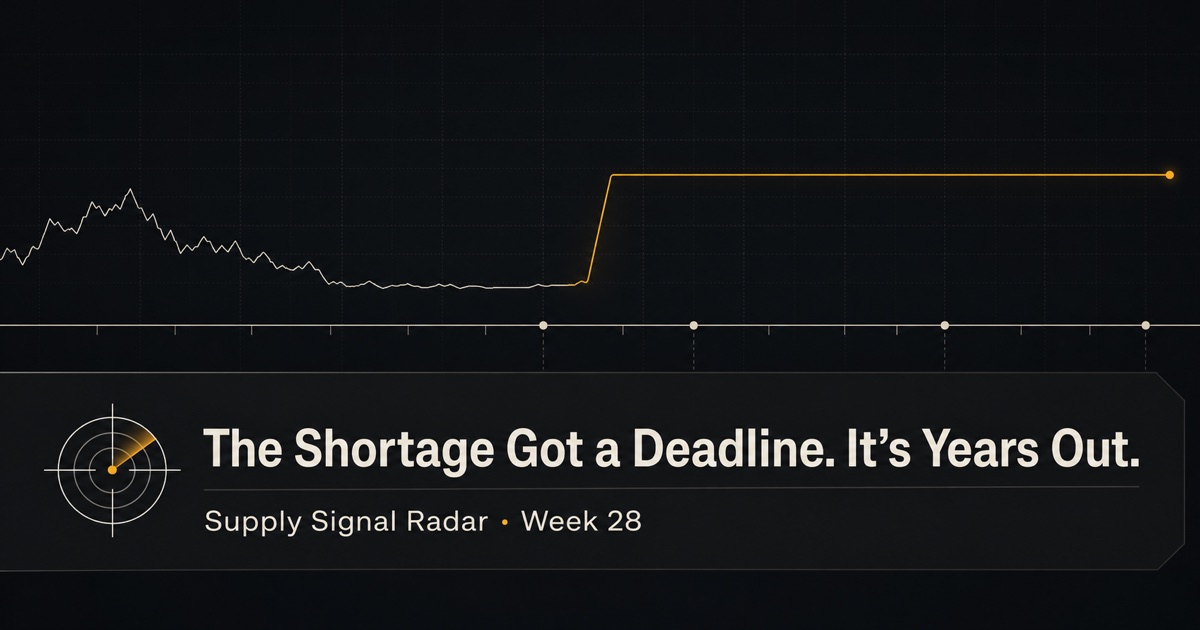
The memory shortage has a deadline now.
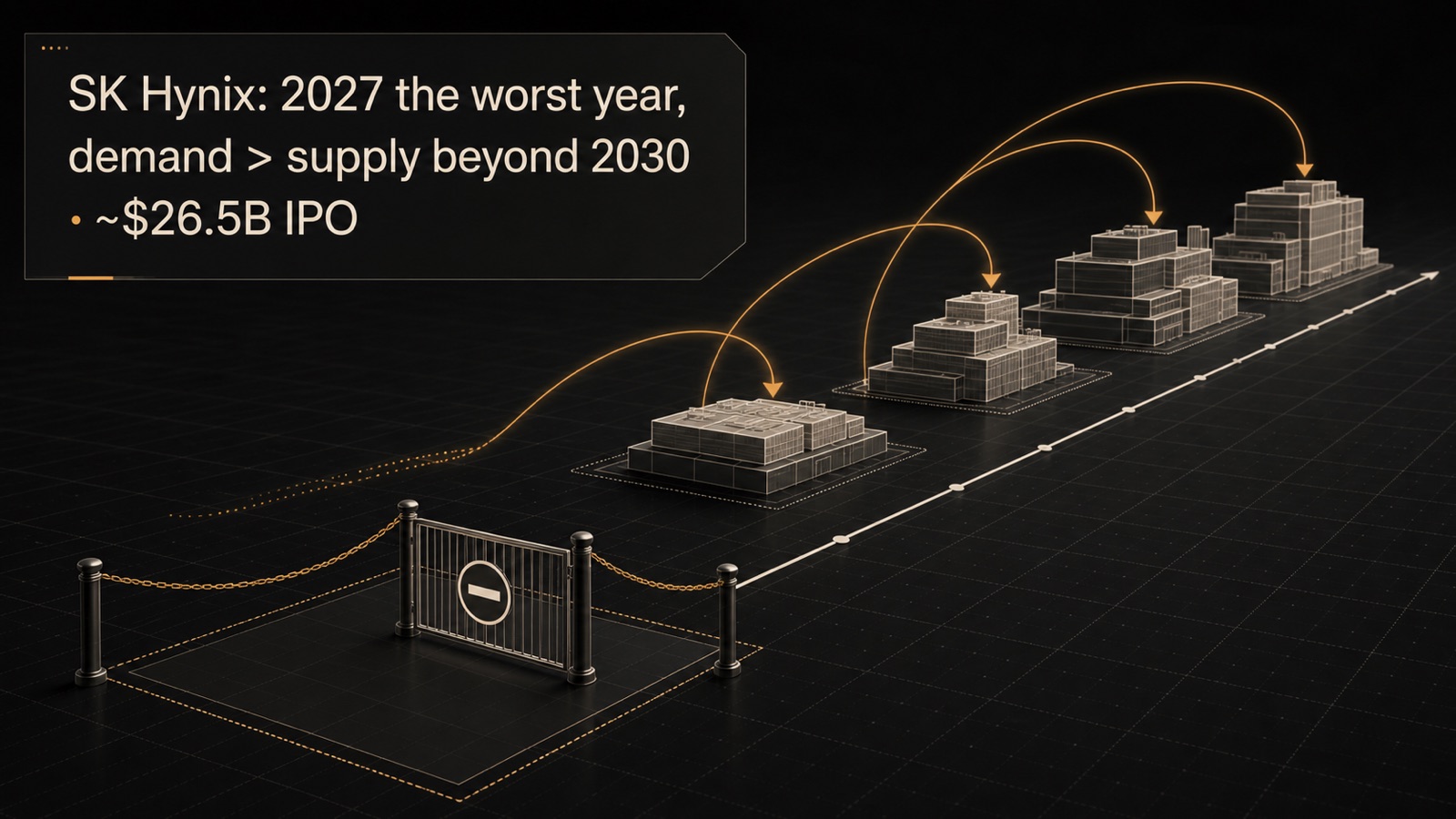
For weeks the question was how high memory costs would climb, and whether they would hold. This week the people who make the parts answered a different one: how long. SK Hynix's CEO said 2027 will be the worst year of the shortage, and expects demand to stay above supply beyond 2030. He made that call as the company's Nasdaq listing raised about $26.5 billion, with the proceeds aimed at fabs, packaging, and equipment. A shortage recent quarters treated as a spike to ride out is now being described — by one of the companies that makes the memory — as a multi-year condition, and financed as one.
Take the forecast with the skepticism it earns. It comes from a supplier that benefits when memory stays scarce; a long shortage supports pricing power, capacity investment, and the story around the IPO. It is a forecast, not a law of nature. But the capital behind it is real. The firms selling the constrained parts are not budgeting for a quick return to normal — they are raising money against years of demand.
For procurement, that moves the question. It is no longer "when does the quote normalize?" It is "which programs stay clear-to-build if the supplier's clock is right?" That is a planning-horizon problem, not a spot-buy one — and it is better answered now than when the product plan is forced to answer it for you.
The Supplier Side Named the Clock
The capital response is lining up behind the longer horizon. Nanya reported a 79.5% gross margin in the second quarter as DRAM average selling prices surged, then said it plans to quadruple 2027 capital spending to about $6.2 billion. That is not a capacity plan built around a soft landing.
Micron has raised its planned US investment to more than $250 billion through 2035 and has started work on its New York fab. It is also committing up to $3 billion to strengthen the US semiconductor supply chain, including strategic financing for GlobalWafers' 300mm raw-silicon wafer facility in Texas. Apple's expanded agreement with Broadcom is expected to exceed $30 billion through 2031 and produce more than 15 billion chips in the US.
These are different companies and different layers of the supply chain. Together, they describe a higher base of committed demand and committed capacity. They do not reopen a constrained memory allocation this quarter. A fab announcement is a future supply event; a wafer reservation, allocation letter, or approved alternate is an operating decision.
The distinction matters most for long-life products. If a controller, industrial gateway, medical device, or service spare depends on a memory family with no qualified migration path, the buying decision may arrive before the new capacity does. Lifetime-buy analysis, multi-year agreements, and requalification work all move forward on that assumption even if the market later loosens sooner than expected.
Our standing view has been that contract DRAM rises more than 10% quarter over quarter this quarter. Nanya's margin and capex signals, together with SK Hynix's capacity financing, support that direction. They do not prove the exact size or duration of the move. The near-term test remains contract pricing, quote validity, and allocation behavior.
The Bottleneck Moved Past Memory
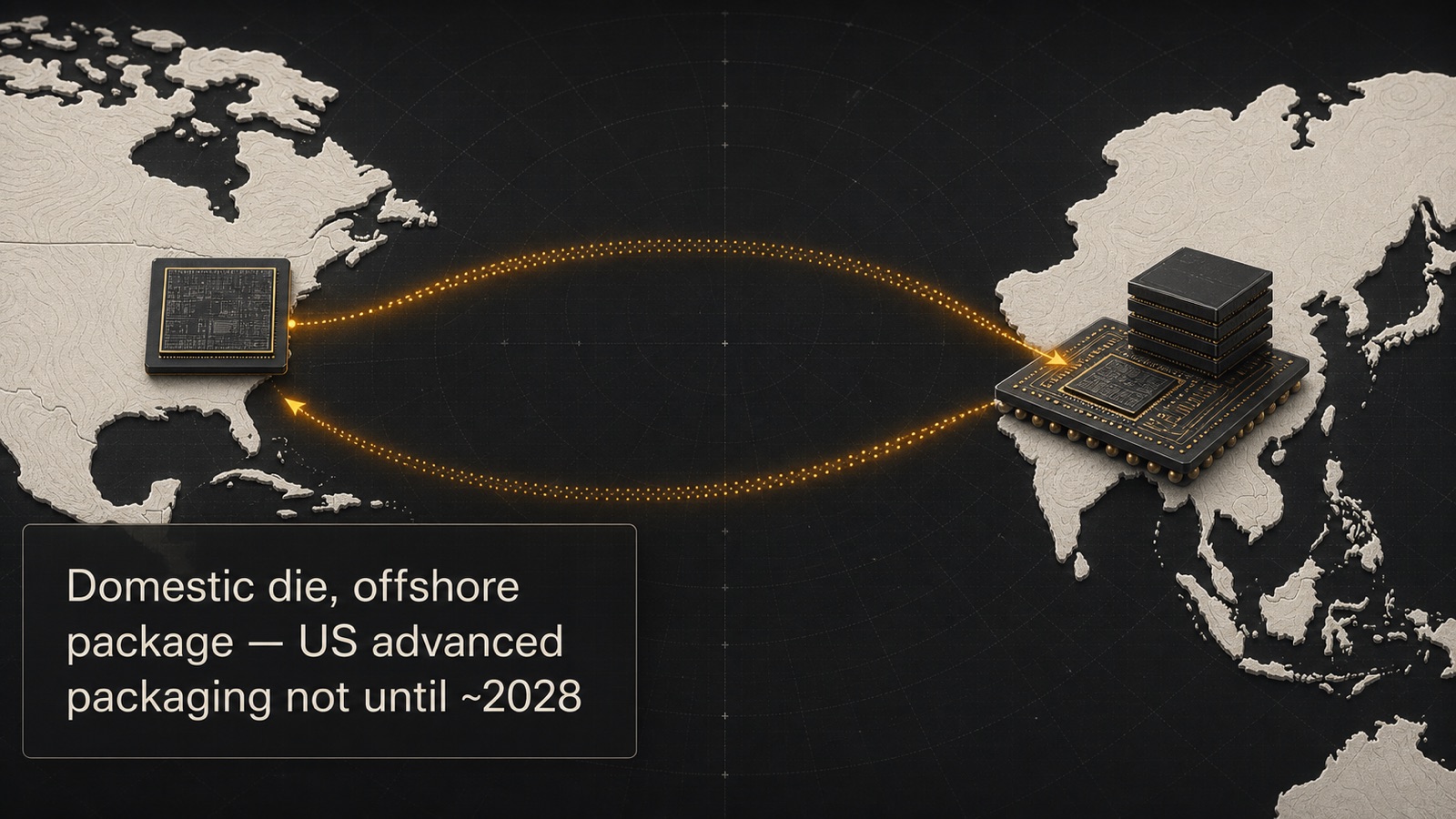
The next constraint is not necessarily another wafer. TSMC's Arizona site can produce Blackwell dies, but the advanced packaging step still takes place in Taiwan. The Blackwell package combines large compute dies and HBM on a silicon interposer, and the US facilities intended to close that packaging gap are not expected to begin production until 2028 at the earliest.
That leaves a finished-product dependency after the wafer leaves Arizona. A domestic wafer does not yet mean a domestic, shippable AI accelerator. For buyers, the relevant map now includes packaging location, substrate and interposer availability, HBM attachment, test, and the transport leg between them.
The same pattern is visible one level higher. SemiAnalysis reported that Nvidia's Kyber NVL144 rack for Rubin Ultra has slipped to 2028 because the PCB midplane remains difficult to manufacture, and that a proposed stopgap was abandoned after customer pushback. Nvidia responded that its roadmap is intact; the specific delay remains a reported manufacturing constraint, not a confirmed Nvidia schedule change.
Either way, the procurement lesson is concrete. More compute demand does not guarantee more deployable systems when the rack architecture depends on a difficult board, a new thermal design, or a scale-up fabric that has not reached production repeatability. The constraint can sit in the interconnect between otherwise available chips.
Power is now part of the same conversation. Oregon regulators approved a new PGE rate structure under the POWER Act, with data centers and other large users facing a reported average increase of 29.7% while other customer classes receive different treatment. The rule is designed to assign more of the grid cost to the loads creating it; it is also a reminder that siting, electricity contracts, and interconnection timing can change the economics of compute hardware after the silicon is available.
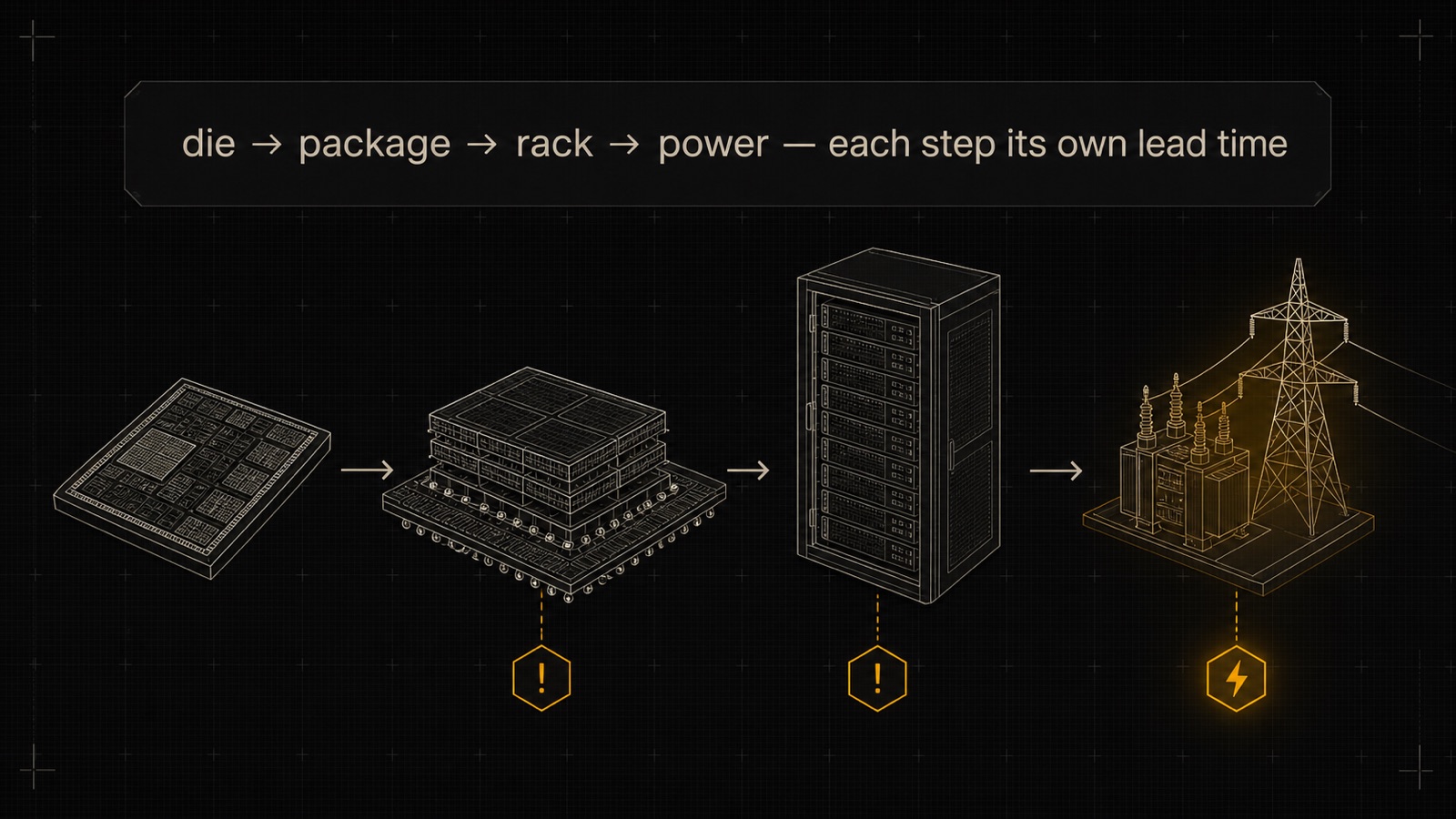
The path is die → package → rack → power. Each step has its own lead time and its own failure mode.
The Horizon Is a Forecast, Not a Law
There is an honest counter-signal. SK Hynix's CEO is describing the market from inside the company that benefits when memory remains scarce. A long shortage supports pricing power, capacity investment, and the story around the IPO. Previous shortage-duration calls have also missed.
The capex cluster makes the forecast more useful, not automatically true. It shows that suppliers are spending as if demand will stay elevated. It does not tell a buyer exactly when a particular MPN will be available, whether a program will receive allocation, or whether a qualified alternate will pass validation.
Most of this week's evidence is forward-looking: 2030 memory demand, 2035 Micron investment, 2028 packaging, a reported 2028 Kyber schedule, and 2027 Rapidus pricing. None of it reopens this month's quote. The value is in changing the planning horizon before the product plan is forced to change it for you.
What to Watch For
- Contract DRAM through this quarter. A rise above 10% quarter over quarter would keep the standing view on track; a sharp slowdown in contract pricing would be the first evidence that the supplier clock is shortening.
- Memory commercial terms. Longer lead times, shorter quote-validity windows, NCNR requirements, or tighter minimums show whether scarcity is moving from price into access.
- Packaging localization. Watch for firm production dates, customer qualification, and real output from the US advanced-packaging projects. Announced capacity is not usable capacity until it passes those gates.
- Kyber and Rubin Ultra execution. A confirmed schedule, a manufacturable midplane, or a credible stopgap would change the rack-level read.
- Power contracts. New data-center tariffs, interconnection milestones, and pass-through language will show which compute projects can absorb the cost of the grid they require.
Two smaller signals belong on the watch list. Wolfspeed filed a patent-infringement complaint against Navitas covering GaN and SiC product lines; the allegations remain allegations, but power-component buyers should keep second sources visible. Rapidus is targeting a 2027 launch price near $20,000 for a 2nm-class wafer, which could matter for future foundry competition but not for a current production release.
What To Do This Week
- Re-rank memory exposure by product life. Separate service-spare, long-life, and active-production requirements. They do not have the same substitute or lifetime-buy decision.
- Put the supplier clock in the program plan. Model 2027 pressure and a beyond-2030 risk case for parts that cannot be requalified quickly. Record the assumption instead of letting it hide in a buyer's note.
- Refresh the dependency map beyond the die. Add packaging site, HBM or substrate dependency, test location, rack interconnect, power availability, and transport legs to the risk review.
- Get commercial terms in writing. Capture allocation volume, delivery dates, quote validity, NCNR language, and substitution rights before the next purchase-order release.
- Set escalation triggers. Define the lead-time, price, or minimum-buy change that forces engineering review, customer repricing, a lifetime-buy decision, or a second-source qualification.
The shortage may ease earlier than the supplier expects. The mistake is planning as though it must.
Plan the product around the time the supplier has named, not the time you wish the quote would normalize.
Chat with Sai — the first month is free for new subscribers. Signal Chat is direct conversational access to Supply Signal, the intelligence agent behind this Radar. Ask which memory generations are repricing, where a foundry pass-through lands on your BOM, or whether a supplier's notice is a temporary surcharge or a new baseline — every answer carries its reasoning and its sources, and every prediction goes on a public, auditable track record. New subscribers get the first month free at semibuffer.com/auth/sign-up. The free weekly brief is at semibuffer.com/radar.
Sources: Reuters on SK Hynix's 2027-2030 outlook, AP on the $26.5B IPO, Nanya capex and margin, Micron's US investment, Micron-GlobalWafers investment, Apple-Broadcom agreement, the Arizona packaging gap, the reported Kyber delay and Nvidia's response, the Oregon PGE rate change, the Wolfspeed complaint, and the Rapidus pricing report. Published weekly by Semibuffer Intelligence.
Related Episodes
- Week 28: The Shortage Got a Deadline — It's Years Out: Week 28: SK Hynix's CEO called 2027 the worst year of the memory shortage and expects demand to outrun supply beyond 2030 — backed by a $26.5B IPO. The suppliers are financing a multi-year shortage, and the bottleneck is spreading past memory to packaging, racks, and power.