Supply Signal
The Shortage Moved to a Material You Don't Buy.
By Semibuffer Intelligence | August 2, 2026 | 9 min read
Memory was the easy shortage.
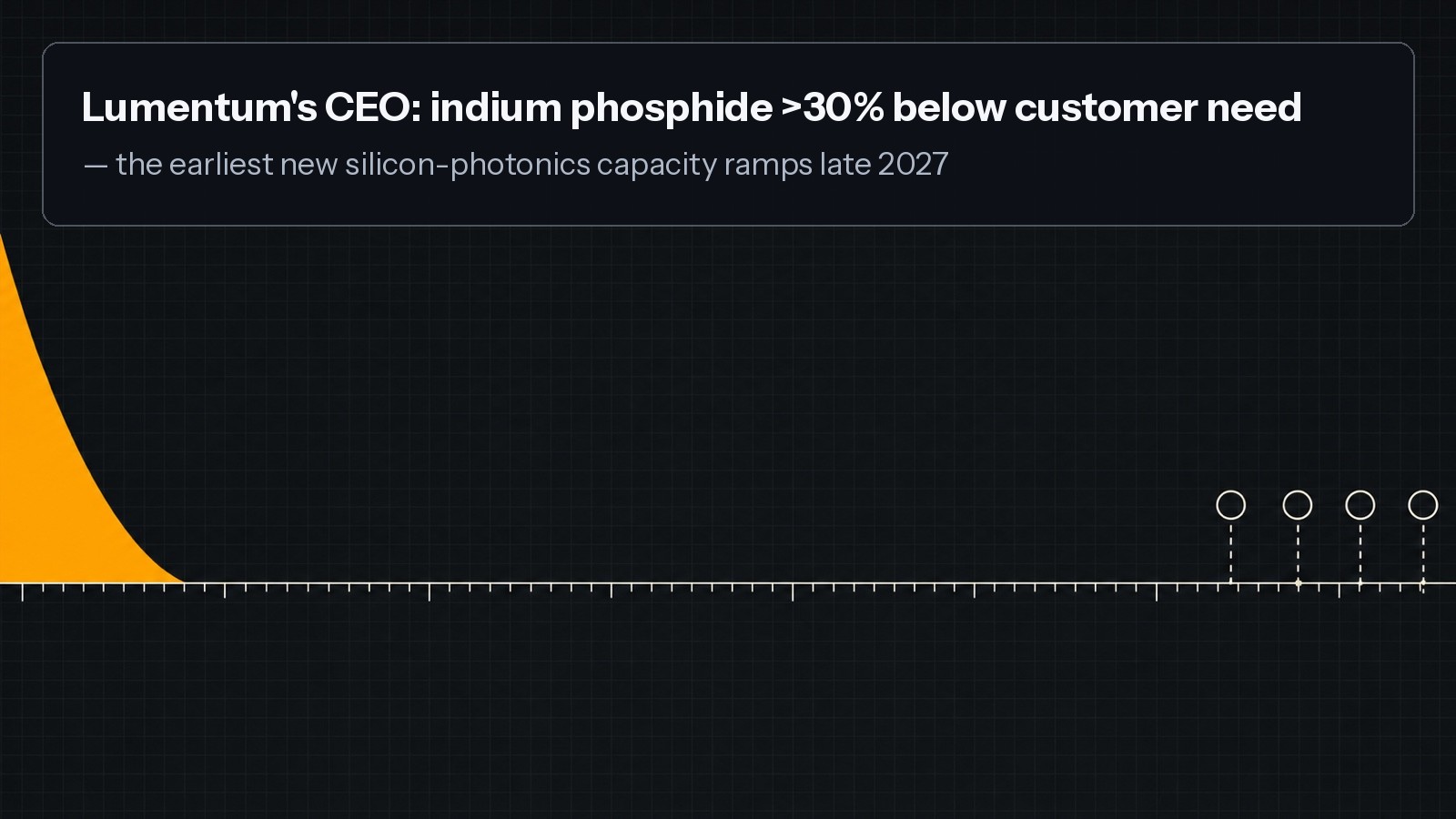
The harder one sits below the part number. Lumentum CEO Michael Hurlston told the RAISE Summit in Paris that the supply-demand imbalance for indium phosphide had widened to “somewhere greater than 30%.” He said the shortage would become “even more acute than what we see from the memory guys.” Those were reported remarks from a July conference appearance, not a new quarterly figure.
For a buyer, the problem is where the material sits. You do not usually buy indium phosphide. You buy an optical transceiver, a laser assembly, or a co-packaged optics module. The substrate and the laser components sit below the line you review in the BOM. There is no simple second source to qualify after the fact, and no memory-style spot market that gives you a clean daily read.
This week, four unrelated parties moved on the same optical bottleneck. At the same time, the general-purpose semiconductor base began competing for the capacity that falling consumer units were expected to free up. The result is a wider sourcing problem: the next constraint may already be inside a supplier's product, while the rest of the BOM is getting busier too.
The Constraint You Can't Second-Source
The first action is to pull optical exposure up one level in your supply review. If an 800G or 1.6T module is critical to your build, the module supplier's indium phosphide, pump-laser, and laser-chip path belongs in the risk file even when those materials do not appear as direct BOM lines.
Hurlston described pump lasers as the biggest issue and as a constraint the industry had not expected. He also said key components were effectively sold out for the foreseeable future. Lumentum is ramping five indium phosphide facilities, but adding a fab does not make its output available this quarter. It creates a future source that still needs tools, material, qualification, and customer acceptance.
That is why the exposure is easy to miss. A buyer can have an approved transceiver supplier, a valid quote, and an apparently healthy part number while the sub-tier material has already become the allocation point. Ask where the laser chips and pump lasers come from, which volumes are committed, and what happens if the module supplier receives less material than its customer forecast requires.
Four Parties Moved on Optics This Week
Corning gives the optics story its hardest number. Core sales reached $4.74 billion, up 17% year over year, while Optical Communications reached $2.072 billion, up 32%. Enterprise Networks, its AI data-center line, grew 65% year over year. Core sales is a non-GAAP measure; the 17% growth rate also holds on a GAAP basis, where total sales were $4.51 billion.
Corning also has demand attached to the buildout. It announced a multiyear, multibillion-dollar U.S. optical fiber, cable, and connectivity agreement with Amazon, plus a long-term NVIDIA partnership to expand U.S. optical-connectivity manufacturing roughly tenfold and fiber production by more than 50%. Its third-quarter core-sales guide is $4.9–$5.0 billion, up 16%. The release speaks to fiber, cable, and connectivity. It does not use co-packaged-optics language.
The capacity response is real. Its dates are the warning.
GlobalFoundries signed a Letter of Intent with the U.S. Department of Commerce covering a proposed $300 million CHIPS R&D award for silicon photonics, optical materials, wafer technologies, and advanced packaging, including near-packaged and co-packaged optics at Malta, New York, and Burlington, Vermont. An LOI is a proposed award, not a finalized or disbursed payment. It shows that the optical constraint is now important enough to receive dedicated public R&D support.
UMC's Singapore P4 expansion is more specific. The cleanroom and tooling are for silicon photonics, with a ramp described as late 2027 or early 2028. Its Tainan work is aimed at advanced packaging, with meaningful production on a later 2028–2029 horizon. The company's language is capital discipline. The procurement read is simple: the relief being built today is aimed at a later allocation cycle.
SEMI's Q2 wafer-shipment report supplies the neutral industry view. Global silicon wafer area shipped reached 3,573 million square inches, up 7.4% year over year and 9.1% sequentially. Ginji Yada of the SEMI Silicon Manufacturers Group said AI demand was spreading beyond advanced logic and memory to power devices, photonics, and other markets, while industrial and automotive demand was recovering.
Four different positions in the chain point in the same direction: optics is becoming a larger production requirement, and the demand is spreading beyond the parts that dominated the shortage story earlier this year. The earliest specific silicon-photonics relief in this set is late 2027 or early 2028. This quarter's allocation is unchanged.
The Packaging Layer Is Already Filling
Amkor is the packaging layer underneath the optical buildout. It reported record second-quarter sales of $1.90 billion, up 26% year over year and 12.6% sequentially, with record Computing and Automotive & Industrial revenue. It guided third-quarter sales to $1.95–$2.05 billion and full-year 2026 capital expenditure to approximately $2.5–$3.0 billion.
Amkor's release supports those financials. Separate coverage of the earnings call put network-wide advanced-packaging utilization in the high 70s, up from the 50s, and described 2.5D and HDFO programs. Treat those utilization and program details as reported call coverage until confirmed against Amkor's own transcript. The procurement point is immediate: a silicon-photonics design can have wafer supply and still wait on advanced packaging capacity.
The Base Came Back for the Rest
The capacity that weaker consumer units were supposed to release now has another bidder.
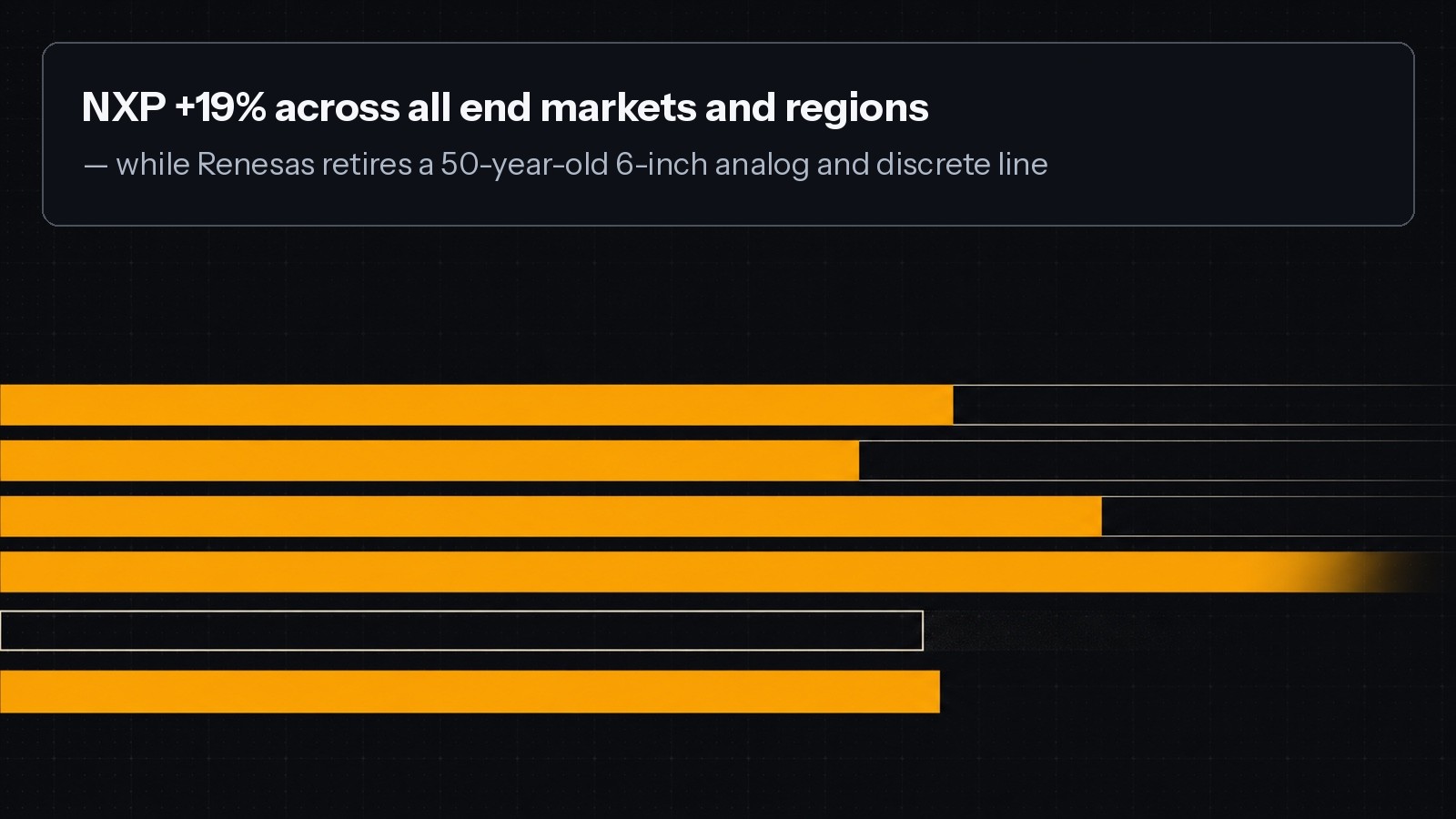
NXP's second-quarter revenue was $3,496 million, up 19% year over year and 10% sequentially, with “growth across all end markets and all regions.” Its third-quarter guide is $3.65–$3.85 billion. That is a broad-based recovery in analog and mixed-signal demand, not a single end-market rebound. Any plan that treated falling consumer units as automatic mature-node relief should be re-run.
Qualcomm gives the more useful split view. Total company revenue was $9.947 billion, down 4% year over year. QCT Automotive revenue was $1.588 billion, up 61%, and Qualcomm says the automotive line has delivered 23 consecutive quarters of double-digit year-over-year growth. QCT Automotive and IoT together grew 28%. The company-wide top line is declining while automotive demand keeps compounding. For a buyer, auto silicon is still taking capacity even when the headline revenue number is down.
Monolithic Power Systems makes the power-device broadening legible at a useful scale. Record second-quarter revenue reached $980.6 million, up 47.6% year over year and 21.9% sequentially. Enterprise Data reached $380.6 million, up 164.3% year over year and 38.8% of revenue. MPS guided third-quarter revenue to $1.14–$1.16 billion, crossing $1 billion per quarter, and reported initial orders for high-speed DDR5 memory power components plus sampling for 800V data-center architectures.
Teradyne's test business shows the same broadening from the other side of the factory. Q2 revenue reached $1.329 billion, up 104% year over year, with record memory revenue driven by DRAM strength and a resurgence in NAND final test. Its Q3 guide is about $1.25 billion at the midpoint, a sequential decline. That decline matters, and it belongs in the counter. The record quarter says output is still moving; the guide is the first mechanical hint that added supply eventually arrives.
Renesas supplies the sharpest live-BOM counterpoint. It is phasing out production at the Takasaki factory's 6-inch (150mm) line, which makes analog ICs and discrete power semiconductors and has operated for more than 50 years. Production is due to end within the next two to three years, but the exact timing is still undetermined. R&D will remain and be strengthened.
On the earnings call, CEO Hidetoshi Shibata said 6-inch products will move to 8-inch and larger lines where equipment support exists, with products either “transferred or discontinued.” Renesas disclosed no capacity figure, revenue share, last-time-buy program, restructuring charge, or firm date. That disclosure gap means a buyer cannot yet size the exit. Any Renesas analog or discrete part in an automotive or industrial BOM should trigger a request for the transfer-or-discontinue list now. “Transferred or discontinued” is a requalification event either way.
The Buildout Is Also a Constraint
The equipment layer says the expansion is funded, but it also says the queue is getting longer before it gets shorter.
Lam Research and KLA independently raised their calendar 2026 wafer-fabrication-equipment outlook to the low-$150 billion range, up from about $120 billion in 2025 and above Lam's prior view near $140 billion. Lam guided the September quarter to $8.10 billion ±$400 million, versus $6.72 billion in the June quarter, and pointed to 8–10 new fabs coming online in 2027.
Two toolmakers converging on the same WFE number is stronger than one company beating its own forecast. Customers are funding the buildout across the chain. For procurement, keep equipment lead times and service parts in the BOM review. A fab starts to relieve chips only after the tools arrive, qualify, and run at usable yield.
SK hynix reported Q2 operating profit of KRW 60.5426 trillion, up 557% year over year, with a 76% operating margin. It is guiding 2026 capex to the high-KRW 40 trillion range, up from KRW 30.2 trillion in 2025. The operating result is the useful shortage evidence; the reported net profit includes a large one-off gain on investment assets and should not be used as a measure of recurring earnings power.
Linde announced a $1 billion investment in two ultra-high-purity gas units in Phoenix, Arizona, supporting two new fabs for an unnamed major U.S. semiconductor manufacturer; no timeline was disclosed.
Ninety-Four Percent, and Not One More Part
The honest counter is that the semiconductor market can grow sharply in dollars without producing a matching number of additional parts.
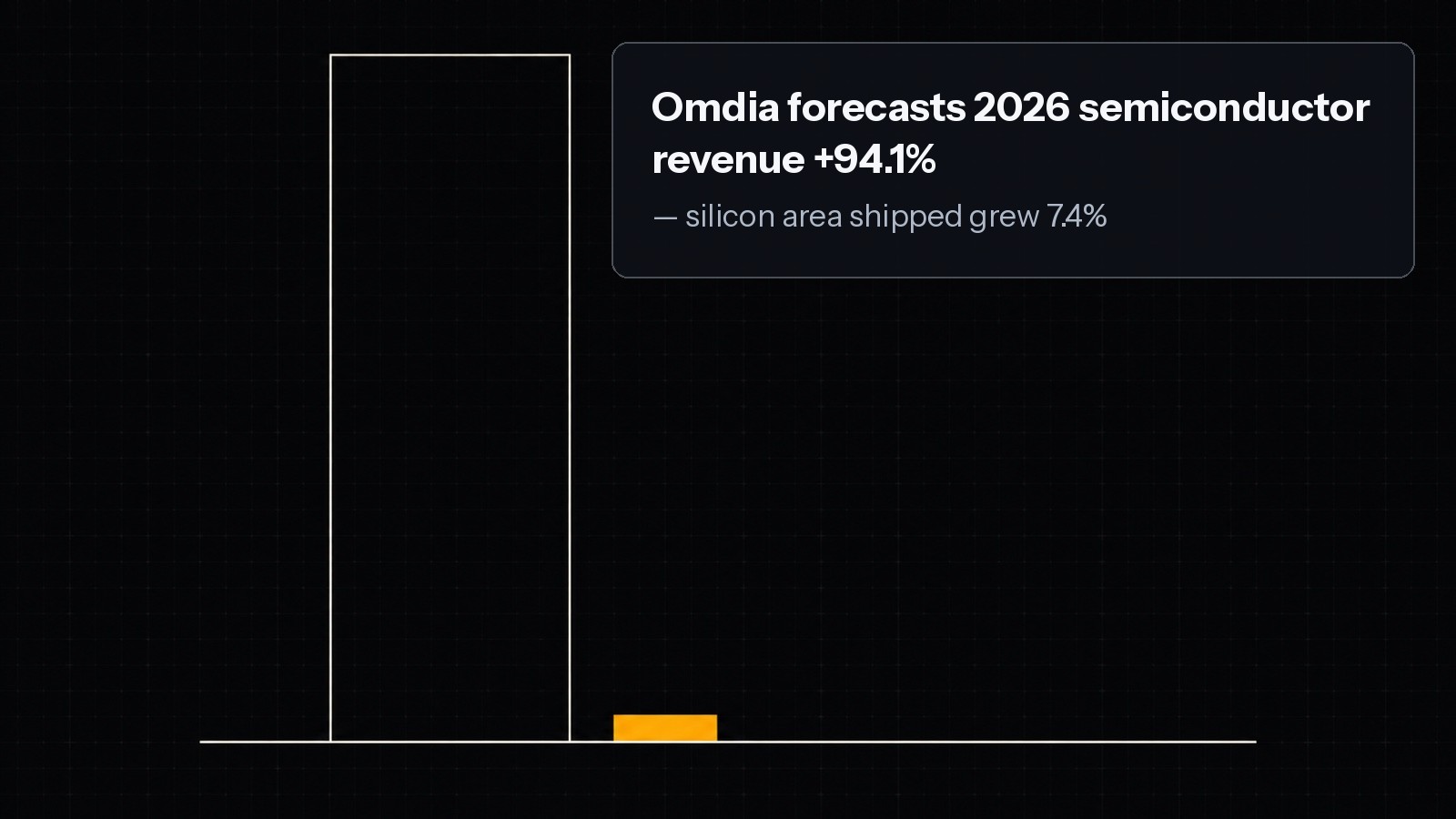
Omdia raised its 2026 semiconductor revenue forecast from 62.7% growth to 94.1%. The forecast applies to the total market, and its framing is ASP-driven rather than unit-driven. Memory ICs are projected to exceed half of total semiconductor revenue in 2026. That is a price and mix story until wafer area moves with it.
SEMI's 7.4% year-over-year increase in shipped silicon area is the number a buyer can turn into physical output. Put beside Omdia's 94.1% revenue forecast, it gives the week's cleanest procurement comparison: much more value is changing hands, while the underlying silicon area is growing by a single-digit amount.
The standing call remains that contract DRAM prices rise more than 10% quarter over quarter this quarter. SK hynix's 76% operating margin and 557% operating-profit growth support the shortage side. Omdia's ASP framing and Teradyne's sequentially lower Q3 guide show how the cycle eventually ends: more capacity is being funded, but it has not reached the buyer yet.
A 94% semiconductor market is therefore not a recovery signal from a procurement seat. The same quantity of silicon can move at a much higher price, with more of the value concentrated in memory. That also limits optimism around silicon photonics: capacity is being funded, but funding is not wafer area, and wafer area is what fills a transceiver order.
What To Watch For
- Indium phosphide delivery paths. Watch Lumentum's five-facility ramp, pump-laser output, substrate commitments, and the point at which module suppliers can provide firm customer allocations rather than broad capacity language.
- Silicon-photonics qualification. Track GlobalFoundries' R&D program, UMC's Singapore P4 tooling, and the first customer-qualified output. Late 2027 or early 2028 is future supply until those steps are complete.
- Corning demand and packaging. Track Corning's Optical Communications growth, its tenfold NVIDIA-linked manufacturing expansion, and Amkor's advanced-packaging buildout. Amkor's release supports the financials; the reported utilization move from the 50s to the high 70s remains secondary call coverage until confirmed against its transcript.
- The memory price call. Watch contract DRAM pricing, SK hynix's capex conversion, and Teradyne's test guidance together. A lower test guide is an early relief signal; its effect on this quarter's call is limited.
- Mature-node competition. NXP's all-market growth and Qualcomm's automotive run are the read-through for analog, mixed-signal, MCU, and power parts that were expected to loosen with consumer weakness.
- Renesas Takasaki. If a Renesas analog or discrete part sits in an automotive or industrial BOM, request the transfer-or-discontinue list now. Do not wait for a final phase-out date that the company has not supplied.
- The equipment queue. Lam and KLA's low-$150 billion WFE view, Lam's $8.10 billion September guide, and the 8–10-fab pipeline describe future capacity. Keep the tool and service-part path in the same review.
- Dollars against area. Keep Omdia's revenue forecast separate from SEMI's wafer-area shipment data. The gap between the two is the part of the market a sourcing plan can actually use.
What To Do This Week
- Add the sub-tier path for every critical optical module. Indium phosphide substrate, laser chip, pump laser, assembly site, and qualified alternate.
- Ask optical suppliers to separate committed volume from capacity plans. Record allocation, material ownership, qualification status, and the date when each additional source can ship.
- Give no current-quarter coverage credit to a future facility, LOI, cleanroom, or gas unit. Keep the date, the missing gate, and the first usable output in the supply plan.
- Re-run mature-node assumptions for analog, mixed-signal, MCU, and power parts. NXP and Qualcomm show that industrial and automotive demand can absorb capacity while consumer units soften.
- Model contract DRAM price and unit scenarios separately. Preserve the more-than-10% quarter-over-quarter price case until the test and wafer-area evidence turns.
- Recheck the rest of the BOM. A transceiver sub-tier, a power device, or a single-source analog line can block the build even when the memory line is covered.
The material you do not buy can still be the material that decides whether you build.
This week's supply response is real, but the useful dates sit years beyond the allocation meeting in front of you.
Chat with Sai — the first month is free for new subscribers. Signal Chat is direct conversational access to Supply Signal, the intelligence agent behind this Radar. Ask where an optical module's hidden dependency sits, which parts of a quote are exposed to memory pricing, or whether a capacity announcement can change your build date — every answer carries its reasoning and its sources, and every prediction goes on a public, auditable track record. New subscribers get the first month free at semibuffer.com/auth/sign-up. The free weekly brief is at semibuffer.com/radar.
Sources: reported coverage of the Lumentum CEO's RAISE Summit remarks, additional RAISE Summit reporting, Corning's Q2 2026 results, the GlobalFoundries CHIPS R&D letter of intent, UMC's second-quarter results and expansion, SEMI's Q2 2026 silicon wafer shipment report, Amkor's Q2 2026 results, NXP's Q2 2026 results, Qualcomm's Q3 FY2026 results, Monolithic Power Systems' Q2 2026 results, Teradyne's Q2 2026 results, the Renesas Takasaki announcement, Lam Research's Q4 FY2026 results, KLA's Q4 FY2026 results, SK hynix's Q2 2026 business results, the Omdia 2026 semiconductor forecast, and Linde's Phoenix investment.
Related Episodes
- Week 31: The Shortage Moved to a Material You Don't Buy: Week 31: the shortage stopped being about memory. Lumentum's CEO says indium phosphide is running more than 30% below customer need and will become more acute than the memory squeeze. Corning's Optical Communications grew 32% with its AI data-center line up 65%, GlobalFoundries signed a proposed $300M CHIPS silicon-photonics LOI, and UMC's Singapore photonics cleanroom ramps late 2027. Meanwhile the general-purpose base came back — and Renesas is retiring a 50-year-old 6-inch analog and discrete line without a date. The honest counter: a 94.1% revenue forecast against 7.4% more silicon area shipped.