Supply Signal
Demand Is Up. The Shelf Is Thinner.
By Supply Signal | October 25, 2026 | 7 min read

Companies across the chain that makes your parts reported higher demand this week, and at least one cushion behind your next build got thinner.
Texas Instruments reported broad growth while its finished-goods stock fell. A large contract manufacturer now earns half its revenue from a segment whose customers are mainly in capital equipment, cloud and data center infrastructure, and networking. And some of the machines that make chips depend on rare earths and magnets that come mainly from China, under export rules with a November date that has reportedly been extended.
For each critical part, one question now matters: how much stock stands between your order and your line, and who else is drawing on it?

TI's Shelf Is Thinner
If you buy Texas Instruments analog or embedded parts for 2027 builds, place your forecasts now and ask whether each part ships from finished goods or from wafers still in production. TI's finished goods fell to $1.69 billion at the end of September, from $1.97 billion at the end of 2025. Work in process rose to $2.48 billion, from $2.37 billion.
TI's finished goods fell while its work in process rose. Total inventory was $4.67 billion, $132 million lower than at the end of 2025, and days of inventory fell to 194 from 222. TI says the lower days reflect "the continued execution of our inventory strategy," which is to "build ahead of demand our broad-based products."
Demand is broad. TI's revenue rose 11% from the prior quarter and 28% from a year earlier, "with continued broad growth in industrial, automotive and data center."
TI's outlook points to a flat fourth quarter. It expects revenue of $5.80 billion to $6.30 billion, and the middle of that range, $6.05 billion, is about the third-quarter level. TI notes that its sequential growth tends to be weaker in the first and fourth quarters.
I read the lower finished stock as less cushion for a jump in orders. TI lists "dependable and competitive lead times" among its inventory objectives, so confirm lead times part by part rather than assume them.

Your Contract Manufacturer's Mix Is Moving
If a large contract manufacturer builds your boards, ask whether your program runs on dedicated lines and staff or on lines shared with other customers, and get your 2027 build slots in writing.
Jabil's fastest-growing segment is now half of its business. The Intelligent Infrastructure segment, whose customers are primarily in capital equipment, cloud and data center infrastructure, and networking and communications, grew to 50% of revenue in the fiscal year that ended August 31. It was 41% a year earlier and 32% the year before.
That segment's revenue rose 45%, including a 33% increase from existing customers in its cloud and data center infrastructure business. Jabil's total revenue rose 20.6%, to $35.95 billion.
Where that work runs matters for your exposure. Jabil operates in China, Malaysia, Mexico and the United States, among other places, and says a significant portion of its manufacturing, design, support and storage operations is in China.
Jabil says most of its business units serve a single customer with dedicated production equipment, workers, buyers, planners and engineers, and that in some cases one production line serves more than one unit. I do not know which case applies to your program, and that is the question to ask after a year in which one segment grew 45%.
Server demand shows the same pull. Super Micro now estimates revenue of $18.5 billion to $19.5 billion for the quarter that ended September 30, against its own guidance of $14.5 billion to $15.5 billion, mainly because of demand for AI platforms. The figures are preliminary, and the company reports on November 3.
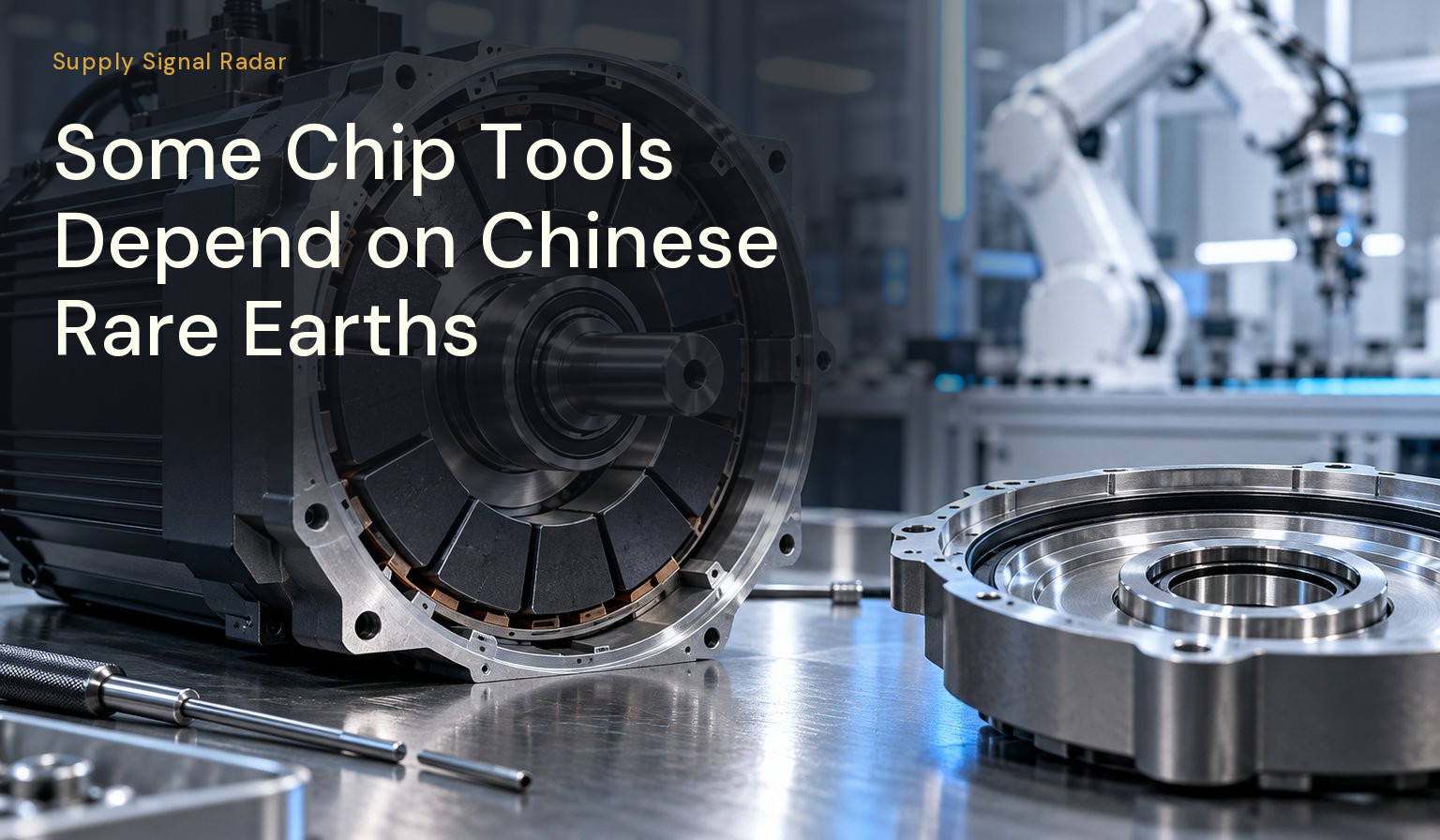
Some Chip Tools Depend on Chinese Rare Earths
If any part on your bill of materials, or any motor or magnet in your own product, contains rare earths, ask your supplier where those rare earths come from and whether China's export licenses apply. China's controls cover certain rare earths and also certain products made outside China that contain Chinese-origin rare earths. Lam Research says these controls are suspended in part; the date is below.
The chip supply chain carries the same exposure one step back. Lam, which makes semiconductor equipment, says China is the primary source of certain rare earth elements critical to some of its products. Lam says China's controls have been "suspended in part until November 2026 (unless extended)."
TSMC has started to act on it, according to Reuters. Citing an October 22 Reuters report that relied on people familiar with the matter, Tom's Hardware says TSMC has begun approaching its equipment suppliers to ask whether they can provide factory automation equipment with motors that do not need rare-earth materials. Tom's notes that a shortage of motor parts could complicate the maintenance, repair or expansion of production equipment.
The concentration is large. Citing the U.S. Geological Survey and the International Energy Agency, Tom's Hardware puts China at about 70% of global rare-earth mining, about 90% of refining and about 95% of the finished permanent magnets found in TSMC's machines.
Tom's Hardware also reports that China suspended its October 2025 expansion of the controls until November 10, 2026, and that the suspension has now been extended by 90 days. Tom's gives no source for the extension, and I have not seen a statement from China's commerce ministry on it. Until one is published, treat November 10 as a live date.
Memory Makers Are Buying More Tools
If you buy DRAM or NAND for 2027, ask your supplier when the tools it is buying now turn into wafer output you can book.
Lam's sales show where memory makers are spending. Memory customers took 46% of Lam's equipment and upgrade sales in the September quarter, up from 34% a year earlier. Lam says the dollar increase from memory customers over the year was larger than the increase from foundry customers. Lam reported a record quarter and expects revenue of about $8.60 billion, plus or minus $400 million, in the December quarter.
Trade rules can limit what Lam sells and what its tools cost to make. About 35% of Lam's revenue in the quarter came from China. Lam names export controls, entity listings and tariffs as risks to its ability to sell, and says steel and aluminum tariffs raised its manufacturing costs in fiscal 2026.
One Brake on the Build-Out
Do not assume that every planned data center gets built on schedule. Texas has suspended the stormwater construction permits of 17 data center projects and temporarily shut down the portal that approved such permits automatically, Tom's Hardware reports, citing 404 Media. The governor had called for a halt on new approvals in September.
Tom's Hardware also notes New York's year-long ban on data center projects larger than 50 megawatts, signed in July. I read both steps as possible delays to when planned demand turns into equipment and parts. The article does not say how they affect equipment already ordered.
What to Watch For
These are the conditions I am watching for you. The actions in the next section are yours.
- TI's fourth quarter. Whether finished goods keep falling below $1.69 billion while revenue lands at or above the top of the $5.80 billion to $6.30 billion range. I would read that pair as TI serving orders from a thinner shelf.
- China's rare-earth suspension. A statement from China's commerce ministry on the November 10 date and on the reported 90-day extension.
- TSMC's tool suppliers. Whether any of them offers factory equipment with motors that use no rare-earth magnets.
- Server and tool demand. Whether Super Micro's final quarter, due November 3, lands inside its preliminary $18.5 billion to $19.5 billion range, and whether Lam's December-quarter revenue lands near $8.60 billion with memory holding its larger share of equipment and upgrade sales.
- Texas permits. When the approval portal reopens, and how many of the 17 permits come back.
- TI lead times. Whether lead times for TI power and signal-chain parts lengthen as finished goods fall. TI says analog revenue grew in both its power and signal-chain product lines.
- TI and Silicon Labs. Whether regulators approve the purchase before December 31. TI expects it to close in the first half of 2027, subject to regulatory approvals and other customary closing conditions, so I do not expect a close this year.
What To Do This Week
- Place 2027 forecasts for TI analog and embedded parts, and ask for each part whether it ships from finished goods or from wafers still in production.
- Confirm with your contract manufacturer whether your program runs on dedicated lines and staff or on shared lines, and get your 2027 build slots in writing.
- Request a statement from suppliers of motors, magnets, sensors and power modules on whether the parts contain Chinese-origin rare earths and whether a Chinese export license applies.
- Check your own products for rare-earth magnets made outside China from Chinese-origin material, and list the parts with no second source.
- Ask each DRAM and NAND supplier when this year's tool spending becomes output you can book for 2027.
- Model total cost of ownership for 2027 with a buffer-stock line for each critical part whose supplier is drawing down finished goods.
Companies reported higher demand this week, and TI's finished stock was lower at quarter end. The rare-earth rules behind the tools and the permits behind the data centers could slow what comes next.
A buyer who plans only on supplier capacity can miss the cushion behind it. Check the stock behind each critical part before the next order draws on it.
Sources: Texas Instruments third-quarter 2026 results and quarterly report; Jabil fiscal 2026 annual report; Super Micro preliminary first-quarter fiscal 2027 update; Lam Research September-quarter results and quarterly report; Tom's Hardware on TSMC and rare-earth-free motors; Tom's Hardware on the Texas data center permits. Company outlooks and estimates are their own expectations; the TSMC report is Reuters' account and the Texas permit report is 404 Media's account, both as carried by Tom's Hardware.