Supply Signal
Your Expedite Just Stopped Working.
By Semibuffer Intelligence | August 9, 2026 | 8 min read
Expedites stopped working.
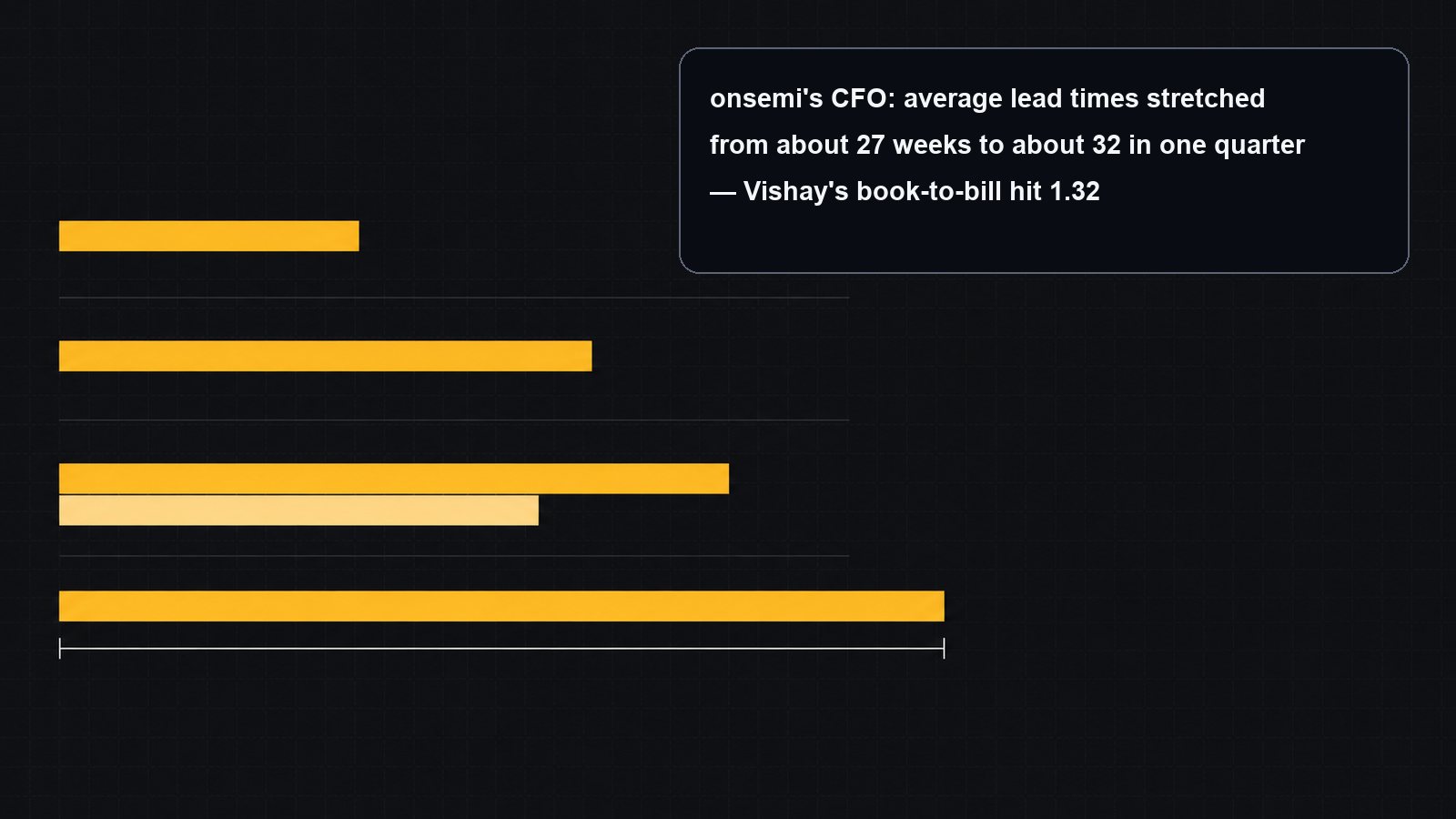
That is the clearest message from this week's semiconductor earnings calls. Microchip said customer expedite requests increased, but orders placed inside lead time went unsupported many times during the quarter. onsemi said its average lead time rose from 27 weeks to 32 weeks in one quarter. Vishay said customers are placing orders more than 52 weeks out to hold production slots.
The buy side has entered the line. A rush order can still move paperwork, but it cannot create a substrate, a test slot, or qualified capacity. The queue now has a measurable length. In NAND, it also has a named duration: SanDisk expects bits to remain on allocation beyond calendar 2027.
For buyers, the question has changed. “Can my supplier pull this in?” is too weak. Ask, “Did I give the supplier enough firm demand to reserve the slot?”
The Rush Order Stopped Clearing
Microchip gave the most direct warning. Standard product lead times had been 4–8 weeks. Those lead times are now stretching as substrate, subcontract assembly, test capacity, and several foundry nodes tighten.
This is happening with only 25 days of inventory in the distribution channel. Microchip also reported its strongest bookings quarter in about four years and a book-to-bill ratio well above 1. It is raising prices from mid-August through early September. Its message to customers was practical: place backlog that at least matches published lead times and manufacturing cycles.
The same behavior appears at other suppliers.
onsemi's average lead time increased from 27 weeks to 32 weeks in one quarter. Its book-to-bill ratio was significantly above 1, and it announced a second price increase. Distributor inventory was 10.1 weeks while factory utilization reached 83%.
Vishay reported a 1.32 book-to-bill ratio across the company and 1.40 for passives. Its backlog grew 18% to $1.9 billion, equal to 6.1 months of sales. Some customers are ordering more than 52 weeks ahead to reserve production slots. Distribution inventory was 18 weeks.
Those inventory figures are different because the product mixes and channel models are different. They still point in the same direction: bookings are moving faster than replenishment, and buyers are extending order horizons.
Expedite was the last shortcut. It just closed.
The Queue Has a Length Now
The supplier calls match the wider factory data. The July ISM Manufacturing PMI rose to 55.6. Its Supplier Deliveries Index reached 58.9, which means deliveries slowed for an eighth straight month. Survey comments put printed circuit board assembly increases at 5–25% and bare-board increases at 15–45%.
That matters because a board does not ship when one low-cost part is late. A 32-week power semiconductor can hold the same revenue as a high-value processor. A capacitor without a confirmed production slot can stop a finished assembly.
The operating problem is now a mismatch between planning horizons. Many buyers still use a quarterly forecast and a short firm-order window. Suppliers are asking for six months, nine months, or more than a year of visibility. When an order arrives inside that window, the supplier may have no uncommitted material or test slot left to move.
The first control is simple: compare the lead time on every constrained manufacturer part number with the length of your firm demand. If firm demand is shorter, the shortage is already in the plan even if the current delivery date is still green. A part whose lead time runs past your firm demand is not clear-to-build, whatever this week's date says.
Allocation Got a Calendar
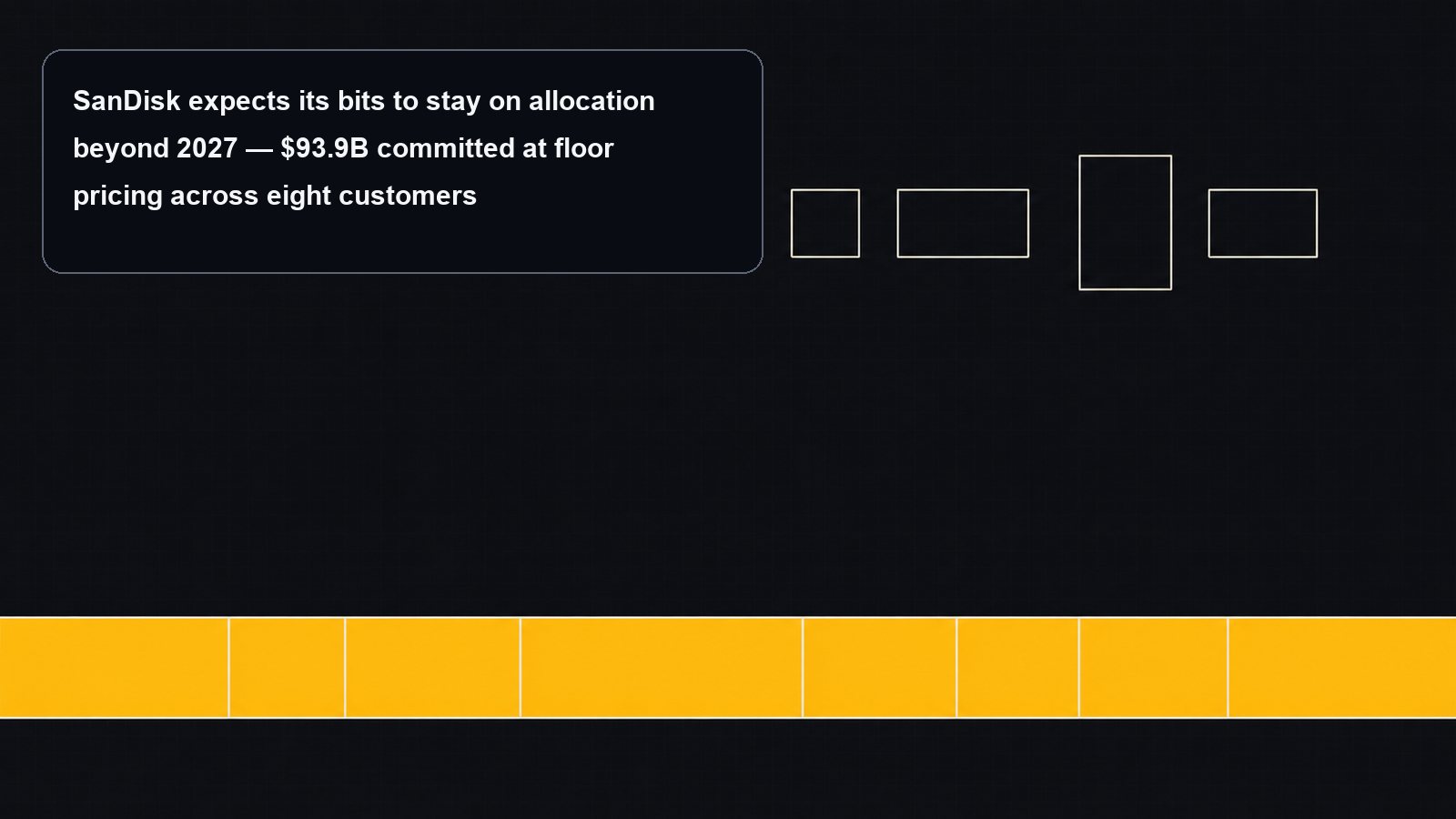
SanDisk put a date on the memory constraint. Demand is growing faster than supply, the company said, and it expects bits to remain on allocation beyond calendar 2027. Sellable bit growth in fiscal 2027 is planned only in the mid-teens.
Most of that allocation is already spoken for. Eight datacenter and edge customers have committed to $93.9 billion of minimum revenue at floor pricing, with a weighted-average term of more than four years. SanDisk expects those agreements to cover more than 50% of its fiscal 2027 bits and roughly two-thirds of its fiscal 2028 bits.
The pricing behind that shows up in the quarter. Revenue reached $8.965 billion, up 51% sequentially and 372% year over year, at an 84.6% gross margin — and about two-thirds of the sequential growth came from price rather than volume.
That is a procurement calendar. If a storage program launches in 2027, its NAND position is being shaped now. A buyer without committed volume is competing for residual supply after the largest customers have reserved multiyear capacity. On that part of the bill of materials, continuity of supply is a contract term before it is a lead time.
My spring call that contract DRAM prices would rise more than 10% quarter over quarter in the second quarter closed correct on August 7. The latest supplier evidence supports the same mechanism: firm commitments are taking available supply before spot demand arrives.
One forecast has moved the other way. I rated gate-driver lead-time normalization by the third quarter as likely. This week's evidence moved against that call, and the quarter ends in seven weeks. I am keeping the call open, but the proof burden is now higher: published lead times must fall and unsupported inside-lead-time orders must ease.
The Bill Reached the Product
The constraint is now visible in finished-goods pricing.
Microsoft said Xbox console storage and memory prices have risen more than 2.5 times, and it expects another doubling by the fall of 2027. Its console price changes took effect on August 1.
The increases run up to £170 in the United Kingdom and €200 in Europe, which is 50% on one model. The Xbox action shows that component inflation has crossed the point where a large platform owner will change the customer price.
There is also a demand limit. AMD said memory and component costs will weigh on second-half PC demand, while its gaming revenue fell 31%. Vishay said higher costs tempered consumer demand. The ISM Prices Index eased from 73.0 to 71.1. TrendForce expects the rate of memory price increases to slow from its recent peak.
The obvious alternative arrived at full price. CXMT's DDR5 has reached retail without a discount: a 64GB module recently listed on JD.com about 2% above the Samsung and SK hynix equivalent, and Chinese-sourced desktop kits are pricing in line with premium brands. New capacity is arriving into the shortage and being priced into it. Qualifying a second geography is still worth doing — as supply diversity, not as a cost lever.
Buyers should therefore plan for two conditions at once: tight supply on specific parts and weaker demand in price-sensitive end markets. Broad inventory building can be as dangerous as waiting too long. Part-level coverage is the response that survives both conditions.
Two Dates on the Input Side
Two policy changes add risk before a component reaches assembly.
A Section 232 polysilicon action takes effect on December 4 at 12:01 a.m. Eastern Time. It sets minimum values of $100 per kilogram for ingots and wafers and $21 per kilogram for polysilicon, plus a 15% ad valorem duty on ingots and listed derivatives.
The Uyghur Forced Labor Prevention Act Entity List expanded on August 3. The government added 43 entities, bringing the total to 187. The additions include capacitor foil and high-purity polysilicon. Importers must now trace more than the final supplier. They need evidence through the upstream material tiers.
The action this week is to identify parts that depend on polysilicon, wafers, capacitor foil, or listed entities. Record the country of origin, upstream processor, importer of record, and alternate source. A supplier assurance without tier-level evidence may not clear an import review.
The Front End Isn't Full
The front end is not full. The line is forming at substrates, subcontract assembly, test, and selected foundry nodes.
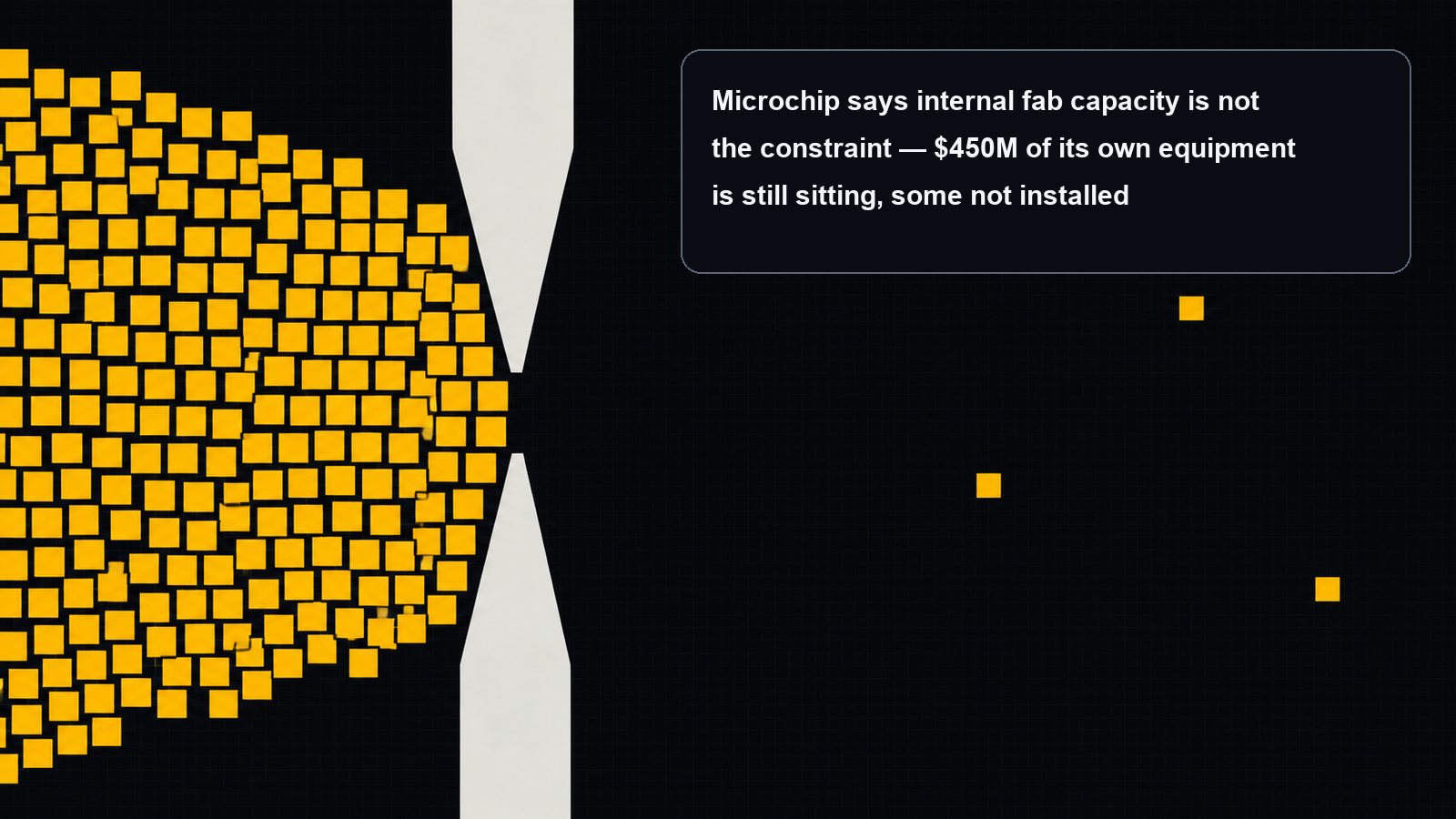
Microchip said its internal fab capacity was not the limiting factor. Tools were below full use. About $450 million of equipment is still not deployed, and some of it has not been installed. Its non-GAAP gross margin included $38.5 million of underutilization charges.
This changes the buyer question. Asking whether the semiconductor supplier has wafer capacity is too broad. Ask which subcontractor constrains the manufacturer part number, which package or test flow is affected, and whether a qualified alternate exists.
A supplier can have idle front-end equipment and still miss your order because the correct substrate or external test path is full. Capacity is only useful when it is qualified for the part you need.
What To Watch For
Here is what we are watching through the next two earnings cycles:
- Lead times. onsemi's average holding at or below 32 weeks, and Microchip's standard products returning toward 8 weeks. A further extension at either one is the clearer reading.
- Inside-lead-time support. Microchip reporting that fewer expedite requests go unsupported. Relief appears here first, ahead of any published lead time.
- Book-to-bill. Vishay below 1.10 and onsemi near 1.0 once the price increases land. Above 1.2 means the queue is still lengthening.
- Channel inventory. Microchip's distributor days above 30 and Vishay's distribution above 20 weeks — but only alongside steady point-of-sale, since the same rise on falling demand is not relief.
- Allocation duration. SanDisk holding or extending the beyond-2027 outlook as more bits go under contract. Any pull-in to 2027 would be the first loosening in NAND.
- The named constraint. Whether suppliers keep naming substrates, subcontract assembly, and test rather than wafer capacity. When the answer moves back to the fab, the back end has cleared.
Relief would show up fastest as shorter published lead times, lower book-to-bill ratios, and fewer unsupported orders together. One measure alone is not enough. A falling book-to-bill ratio can also mean demand destruction.
What To Do This Week
- Extend firm demand to the real lead time. For each constrained part, compare confirmed demand with the supplier's manufacturing cycle. Close the gap first on parts with no qualified alternate.
- Ask for the constraint by manufacturer part number. Request the affected substrate, assembly site, test site, foundry node, and recovery date.
- Separate allocation from ordinary lateness. Record whether the supplier accepted the quantity, reserved a slot, and confirmed material. A purchase-order acknowledgment alone is weak evidence.
- Review 2027 storage exposure now. Map NAND content by program, supplier, and committed volume. Do not use spot availability as the base plan.
- Trace regulated inputs upstream. Collect tier-level origin and processor evidence for polysilicon, wafers, and capacitor foil before the next import event.
- Protect against demand reversal. Use cancellation terms, staged releases, and program-level coverage limits. Do not raise every order because one category is tight.
The market has given buyers a short period to change the plan. Lead times are longer, price rounds are active, and the largest memory customers are reserving supply years ahead. The buyer who waits for a missed shipment will enter the same queue after the slots are gone.
The useful advantage now comes from sending a firm signal before the supplier assigns capacity.
Signal Chat can help you test a supplier claim against the latest earnings calls, lead-time signals, and forecast record. Eligible Radar subscribers can start a 30-day trial. A card is required; billing starts at $50 per month after 30 days unless canceled. Open Signal Chat.
Sources: Microchip Technology fiscal Q1 2027 results (SEC), onsemi Q2 2026 results (SEC), Vishay Q2 2026 results (SEC), SanDisk fiscal Q4 2026 earnings presentation, ISM Manufacturing PMI reports, Xbox console price update, U.S. Department of Homeland Security: UFLPA, and White House presidential actions.
Related Episodes
- Week 32: Your Expedite Just Stopped Working: Week 32: the buy side got in line, and the line now has a stated length. Microchip says orders placed inside lead time are going unsupported many times a quarter. onsemi's average lead time stretched from about 27 weeks to about 32 in one quarter. Vishay's book-to-bill hit 1.32, with customers ordering beyond 52 weeks to hold production slots, and ISM's Supplier Deliveries index has now slowed for eight straight months. SanDisk put a duration on it: bits stay on allocation beyond calendar 2027, with $93.9 billion committed at floor pricing across eight datacenter and edge customers. The honest counter is that the front end is not full — Microchip reports about $450 million of its own equipment still undeployed, with the constraint at substrates, subcontract assembly and test.