Supply Signal
You're Escalating at the Wrong Tier.
By Semibuffer Intelligence | August 16, 2026 | 9 min read
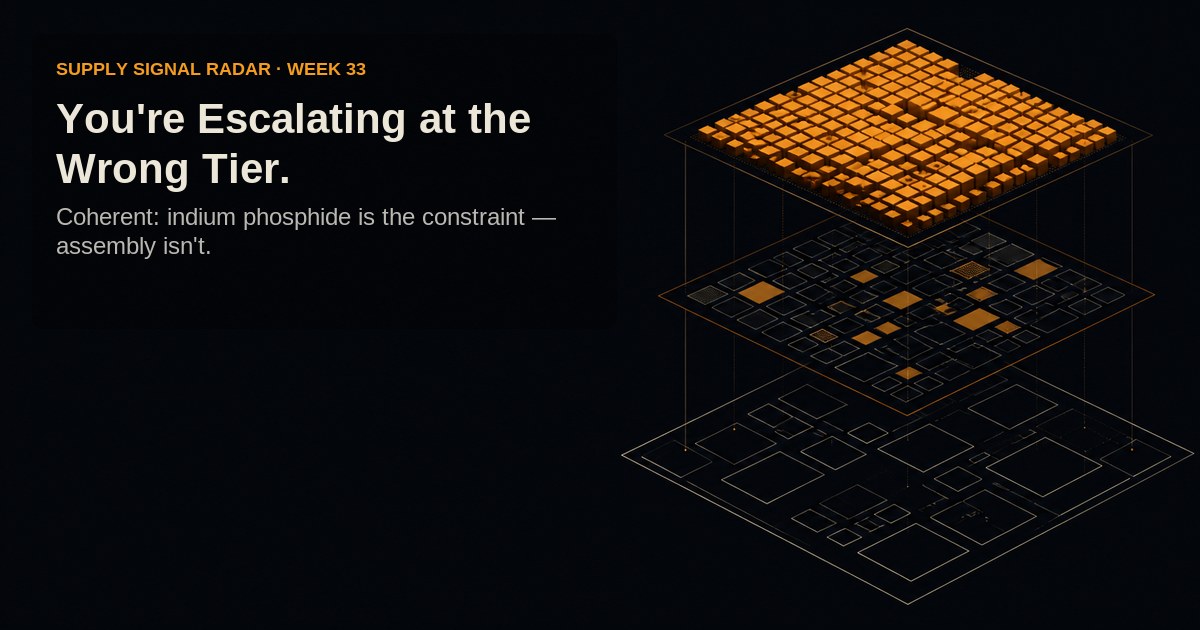
The optics queue starts three tiers up.
The main constraint sits upstream from the module line, inside the laser. More precisely, it sits in the indium phosphide substrate and epitaxy used to make that laser.
Coherent said indium phosphide capacity is its primary constraint. It also said assembly and test capacity is not constrained. Lumentum said it is still shipping behind demand on electro-absorption modulated lasers, or EMLs. It is much further behind on high-power lasers and effectively sold out on pump lasers. Lumentum went upstream to AXT for more substrate. AXT says its backlog runs into 2027.
Three companies sit at three points in the same chain: substrate, laser and optical module. They described the same limit.
For buyers, the escalation path is wrong. Asking a module maker to expedite a transceiver does not create the laser needed to complete it. Ask which laser type is short, which epitaxy line supplies it and whether the substrate volume is reserved.
The Module Line Has Room
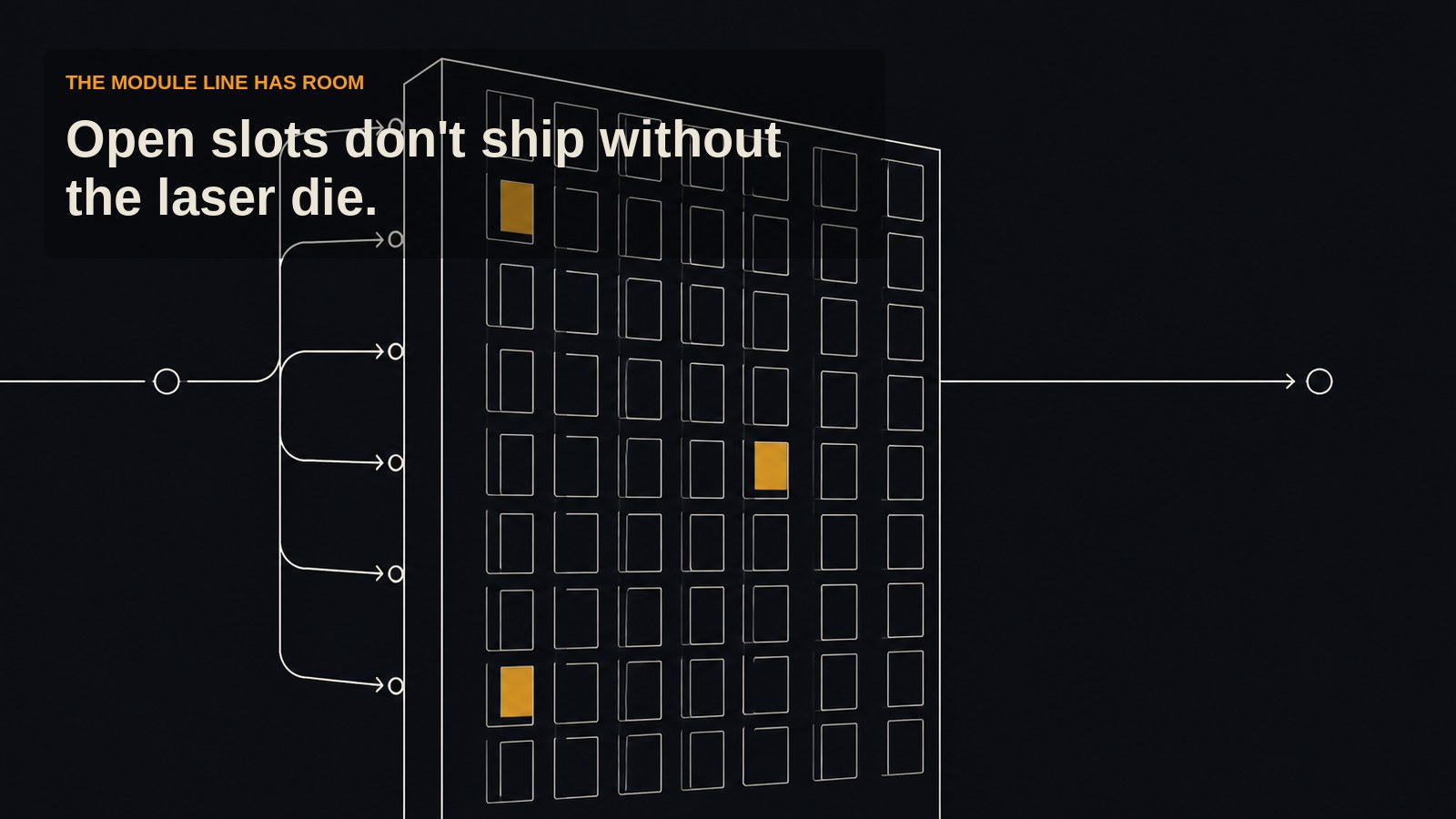
Coherent gave the clearest location test of the week.
Its fiscal fourth-quarter revenue reached $2.05 billion, up 34% year over year. On the August 12 earnings call, chief executive Jim Anderson said indium phosphide remained the company's primary constraint. He then separated it from the visible production step: assembly and test capacity was not constrained.
That distinction changes the buyer's work. A supplier can have labor, test equipment and open module slots, yet still miss the delivery because it has no laser die to install. An escalation sent to final assembly will produce meetings and revised dates. It will not produce more wafers.
The correct questions are specific:
- Is the constrained item an EML, a continuous-wave laser or a high-power pump laser?
- Is the laser made on an internal or external epitaxy line?
- Which substrate supplier supports that line?
- Is substrate volume reserved against the program, or only forecast?
- What qualified laser sources can the module design accept?
If the supplier cannot answer those questions by manufacturer part number, the recovery date is weak.
The Gap Moved Inside the Laser
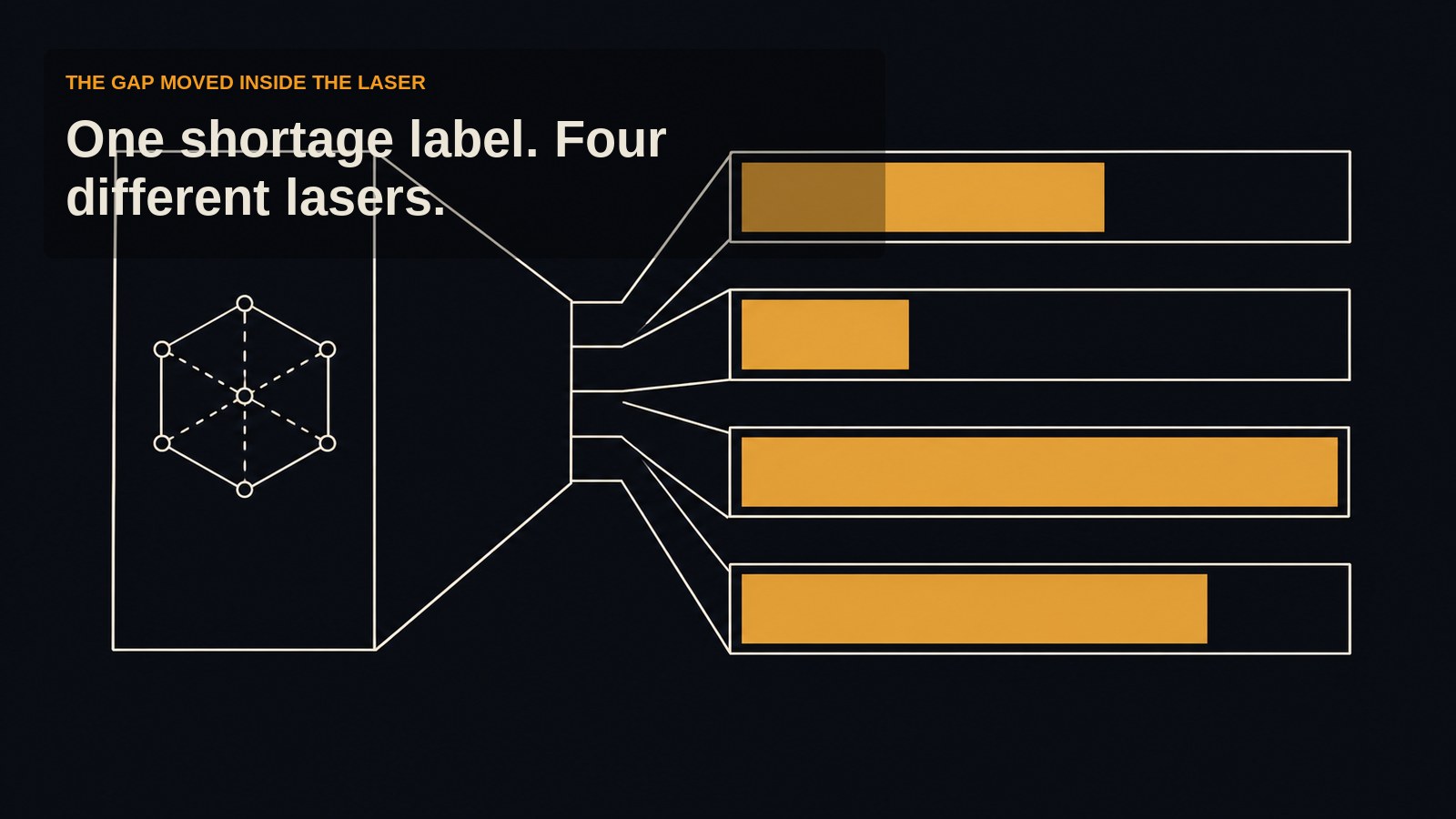
Lumentum showed why a category-level shortage label is already stale.
The company reported fiscal fourth-quarter revenue of $1,006.3 million, up 109.3% year over year, and guided the next quarter to $1.225–$1.275 billion. Pump-laser shipments rose more than 80% year over year. Management said the company would remain effectively sold out on those lasers for the foreseeable future.
The EML gap did not materially change. When an analyst asked whether the prior gap of about 30% had moved, chief executive Michael Hurlston said there was probably no change and that shipments remained behind customer demand.
The deterioration appeared elsewhere. Hurlston said Lumentum was much further behind on high-power lasers. The company had already found added substrate supply from AXT and expected to seek more help because demand had increased.
That is the operating change. A risk register that says only “EML shortage” is tracking last quarter's problem. Pump lasers are sold out, and high-power lasers are the line that worsened.
Customers are responding by using any laser source they can get, according to Lumentum president Wupen Yuen. That behavior can protect near-term output, but it raises a qualification question. A source is useful only if the optical design, reliability evidence and customer approval accept it.
Co-packaged optics, external laser sources and near-packaged optics are also beginning to move optics closer to the rack. Lumentum called these the first signs of in-rack penetration. That is an early reading, not a completed transition. It does mean that laser qualification decisions made now can reach more architectures than the pluggable module in front of the buyer.
The Substrate Book Runs Into 2027
AXT closes the chain.
The substrate supplier reported on July 30, before this issue window, but Lumentum named it on this week's call. AXT's second-quarter revenue was $47.6 million, and the company recorded its highest quarterly indium phosphide revenue to date.
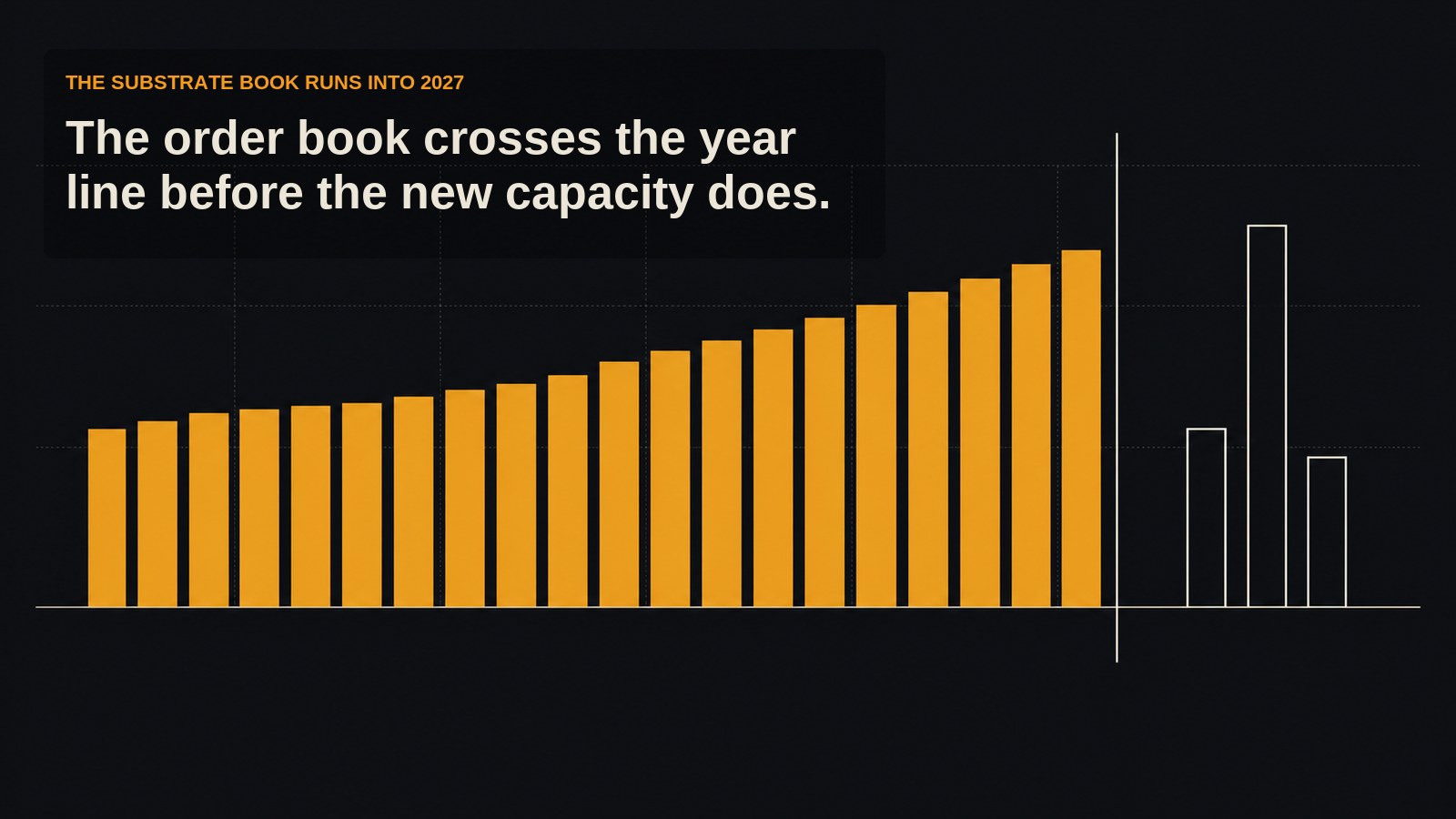
On its call, AXT said demand continued to outpace supply as it added capacity. Its backlog extends into 2027. The company is working to double indium phosphide capacity during 2026 and says that work is ahead of schedule.
Coherent is also moving faster. It expects to double internal indium phosphide output by the end of the current quarter, one quarter ahead of its original plan. It then expects to more than double output again by the end of calendar 2027. Its 6-inch lines in Texas and Sweden are producing EMLs, continuous-wave lasers and photodiodes. One 6-inch wafer can provide four times the output at half the cost of a 3-inch wafer, according to Coherent.
This is the strongest counter to the shortage case: suppliers are adding capacity early, yields are working and the visible assembly tier has room. Relief can arrive.
It will not arrive evenly. The first Coherent doubling is due this quarter. The next step runs to the end of 2027. AXT's order book already covers 2027. Buyers need to know which program receives the added output between those dates.
There is also an incentive to state plainly: each supplier benefits when customers place earlier orders and make longer commitments. A constraint statement helps that commercial position. Three independent tiers reporting the same condition make this case credible.
The spring warning that indium phosphide could become worse than the memory squeeze came through trade-press coverage of conference remarks. Outlets rendered the wording inconsistently. The August earnings calls now place the constraint, capacity plan and backlog on the record.
The Rest of the Channel Has No Cushion
The optics shortage is specific. The wider channel still matters because it shows whether buyers can absorb another constrained category.
Diodes reported on August 5, just before this issue window, that second-quarter revenue reached $445.5 million, compared with $366.2 million a year earlier. It guided the next quarter to about $510 million, plus or minus 3%. At the midpoint, that is 30% growth year over year and 14% sequentially.
The call supplied the useful inventory detail. Global point-of-sale reached a record, while channel inventory fell below Diodes' normal 11–14 week range. Management also said it did not see double booking or duplicate shipments building channel stock.
Avnet reported the same week as Diodes that fiscal fourth-quarter revenue rose 48% to $8.3 billion while inventory days fell to 71. Electronic Components inventory was below 65 days. A distributor growing that quickly while reducing inventory days offers little hidden buffer.
My standing call says gate-driver integrated-circuit lead times normalize by the third quarter. I rated it likely. With about six weeks left in the quarter, the proof burden has not been met. Diodes and Avnet point against normalization.
One supplier points the other way. Alpha and Omega Semiconductor reported revenue down 3.5% year over year to $170.4 million and guided the September quarter below consensus. Commodity power parts remain available. The call remains open until quarter end, but the aggregate evidence now points toward it closing against me.
That split is important. An indium phosphide shortage is not permission to raise orders across the full bill of materials.
Capacity Money Has a 2028 Date
Applied Materials shows how far upstream commitments now extend.
The equipment maker reported record fiscal third-quarter revenue of $9.12 billion, up 25% year over year. Chief financial officer Brice Hill said Applied has the capacity to double quarterly system output from current levels by 2028. A later expansion gives it the option to support more demand by 2030. Customer conversations now extend to 2030, with longer-horizon purchase orders and scheduled deliveries.
The disclosure concerns customer ordering behavior. Applied disclosed no quoted lead-time extension of its own. Chipmakers are reserving equipment on a multi-year horizon, while the equipment supplier needs until 2028 to double its own output.
About $90 billion of other commitments landed around the same period. SK hynix approved two fabs with cleanroom dates in December 2028 and June 2029. TSMC approved about $29.44 billion of capital appropriations, without naming a period. TSMC and Sony formed a smartphone image-sensor venture with volume production expected in 2029. Intel priced a $20 billion stock offering, with about $19.7 billion of net proceeds for general corporate purposes that may include capital expenditure and working capital.
The money confirms confidence in demand. The related output starts too late for a 2027 build plan.
A Draft Risk, Not a Rule
Reuters reported on August 4 that the Federal Communications Commission was drafting a proposal to restrict imports of new models of Chinese-made optical transceivers, based on people familiar with the plans. There is no FCC document, docket, proposed rule, comment period or verified statutory basis. TrendForce separately estimates that Chinese optical-module makers will represent about 56% of global contract manufacturing capacity in 2026. That is a capacity estimate, not market share. Log the manufacturing origin of each transceiver model now, but do not plan against a rule that does not exist.
The polysilicon action covered last week is now published in the Federal Register. It takes effect December 4, 2026, at 12:01 a.m. Eastern Time, with minimum import values of $21 per kilogram for polysilicon and $100 per kilogram for ingots and wafers, plus a 15% duty. Buyers have about sixteen weeks to reprice affected contracts and confirm country of origin.
What To Watch For
- The named laser. High-power and pump-laser availability improving while the EML gap holds. A broad “optics” update is not enough.
- The first doubling. Coherent reaching its indium phosphide output target by the end of the current quarter, one quarter early.
- Substrate backlog. AXT pulling any 2027 orders into 2026, or reporting that backlog extends farther into 2027.
- Qualification behavior. Module makers adding approved laser sources without restarting full customer qualification.
- Channel inventory. Diodes returning to the 11–14 week range while point-of-sale remains firm. Rising inventory with falling sell-through is not relief.
- The gate-driver call. Published lead times falling before quarter end. Revenue weakness at one power supplier is not enough to prove normalization.
- Policy evidence. An FCC docket or published text. Until one appears, the transceiver restriction remains a Reuters-reported internal draft.
What To Do This Week
- Move the escalation upstream. For each late optical module, identify the laser type, epitaxy source and substrate supplier before the next supplier call.
- Reserve the laser, not only the module. Ask whether laser volume is allocated to your program and whether that allocation is firm through the build horizon.
- Recheck the risk category. Split EML, continuous-wave, high-power and pump lasers. Do not manage them as one optics shortage.
- Qualify by design path. Record which alternate laser sources the module design and end customer already accept. A source without qualification is not available capacity.
- Keep inventory selective. Protect the optical and power parts with confirmed evidence. Do not raise every order because one material tier is constrained.
- Record manufacturing origin. Map the country of manufacture for each optical transceiver model. Treat the reported FCC work as a risk to monitor, not a rule to execute.
- Separate 2027 supply from 2028 capacity. Do not use a fab announcement or equipment expansion as proof that next year's requirement is covered.
The shortage is not where the purchase order ends. It is where the laser begins.
That is why the fastest escalation this week may be the one that skips the module factory and reaches the substrate book.
Signal Chat can help you test a supplier claim against the latest earnings calls, lead-time evidence and forecast record. Eligible Radar subscribers can start a 30-day trial. A card is required; billing starts at $50 per month after 30 days unless canceled. Open Signal Chat.
Sources: Coherent Q4 FY2026 results, Lumentum Q4 FY2026 results, AXT Q2 2026 results, Diodes Q2 2026 earnings call, Applied Materials Q3 FY2026 earnings call, Federal Register, August 11, 2026, TrendForce research, and Intel investor news.
Related Episodes
- Week 33: You're Escalating at the Wrong Tier: Week 33: the optics queue starts three tiers up. Coherent says indium phosphide capacity is its primary constraint — and that assembly and test are not. Lumentum is effectively sold out on pump lasers, the EML gap held while high-power lasers worsened, and substrate supplier AXT's backlog runs into 2027. Three tiers of one chain, one limit, with dated relief: Coherent doubles internal indium phosphide output this quarter, a quarter early, and again by end of 2027. Meanwhile Diodes' channel inventory sits below its normal 11–14 week band against record point-of-sale, and about $90 billion of new capacity commitments produce nothing before 2028.